Types of Executive Coaching

Article Banner

Executive coaching is a structured, goal-oriented, one-on-one development process in which a trained coach partners with a senior leader to enhance their leadership effectiveness, decision-making, and overall impact on the organization.

Think of it as a personalized, confidential space for leaders to step back from the daily grind, reflect on challenges, explore new perspectives, and build strategies for both professional and personal growth by doing Executive Coach training. Now let us look at it in detail.

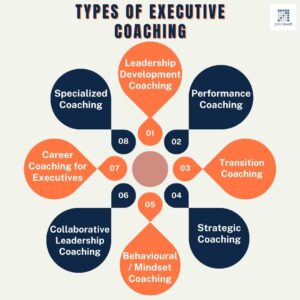
Here’s a clear breakdown of the main types of Executive Coaching, each tailored to specific leadership needs and contexts:

1) Leadership Development Coaching:

is a form of executive coaching that focuses on strengthening a leader’s ability to inspire, guide, and drive their teams and organization toward long-term success. ICF certification, ICF coach training can enhance the skills.

Purpose

To help leaders refine their leadership style, expand their skill set, and align their actions with the organization’s vision and values. It’s not just about fixing weaknesses—it’s about elevating leadership impact.

Key Areas of Focus

  1. Vision & Strategic Thinking
  2. Communication Skills
  3. Decision-Making
  4. Emotional Intelligence
  5. Team Leadership
  6. Change Management
  7. Authentic Leadership

Best Suited For

  • Newly promoted leaders needing to step into higher responsibility.
  • Senior executives looking to refine influence and strategic presence.
  • High-potential managers preparing for top leadership roles.

2) Performance Coaching:

is a targeted form of executive coaching designed to help leaders and professionals achieve specific, measurable improvements in their work performance. It focuses on closing gaps, amplifying strengths, and driving results in alignment with business objectives.

Purpose

To maximize individual and team productivity by enhancing skills, mindset, and execution capabilities. It’s results-oriented, often tied to clear performance metrics.

Key Areas of Focus

  1. Goal Setting & Clarity
  2. Time & Priority Management
  3. Decision-Making Efficiency
  4. Accountability & Ownership
  5. Problem-Solving Skills
  6. Focus & Productivity
  7. Skill Mastery

Best Suited For

  • Leaders needing to hit ambitious targets or turn around performance.
  • High-potential employees preparing for stretch assignments.
  • Teams facing critical deadlines or underperformance issues.

3) Transition Coaching:

is a specialized form of executive coaching that supports leaders as they navigate significant role changes, career moves, or organizational shifts. Its goal is to help them adapt quickly, maintain confidence, and succeed in their new environment. ICF certification, ICF coach training help in a smooth transition coaching skill.

Purpose

To smooth the adjustment period during transitions, ensuring the leader not only adapts but thrives in their new role or situation.

Key Areas of Focus

  1. Role Clarity
  2. Cultural Adaptation
  3. Stakeholder Management
  4. Mindset & Resilience
  5. Skill Gap Bridging
  6. Quick Wins Strategy

Best Suited For

  • Newly appointed executives wanting a strong start.
  • Leaders moving to cross-functional or global roles.
  • Professionals pivoting careers into leadership.

4) Strategic Coaching:

is an executive coaching approach that focuses on enhancing a leader’s big-picture thinking, long-term vision, and decision-making so they can guide their organization toward sustained success. It’s about shifting from operational focus to strategic leadership.

Purpose

To help leaders think beyond day-to-day challenges, anticipate future trends, and make decisions that position the business for long-term advantage.

Key Areas of Focus

  1. Vision Development
  2. Strategic Thinking Skills
  3. Scenario Planning
  4. Business Model Innovation
  5. Resource Alignment
  6. Stakeholder Alignment
  7. Decision-Making Under Uncertainty

Best Suited For

  • C-Suite executives shaping the company’s future direction.
  • Senior leaders driving major transformation initiatives.
  • Entrepreneurs scaling their business into new markets.

5) Behavioural / Mindset Coaching:

is an executive coaching approach that helps leaders shift unproductive behaviours, challenge limiting beliefs, and develop a growth-oriented mindset so they can lead more effectively.

Purpose

To create deep, sustainable change in how a leader thinks, reacts, and interacts—because leadership success is as much about mindset and behaviours as it is about skills and strategies.

Key Areas of Focus

  1. Self-Awareness
  2. Emotional Intelligence
  3. Limiting Beliefs
  4. Resilience & Adaptability
  5. Leadership Presence
  6. Conflict Management
  7. Growth Mindset

Best Suited For

  • Leaders whose technical skills are strong but interpersonal impact needs improvement.
  • Executives preparing for high-pressure, high-visibility roles.
  • Leaders dealing with feedback around communication, empathy, or adaptability.

6) Team & Collaborative Leadership Coaching:

is a coaching approach that focuses on helping leaders build high-performing, trust-based teams and foster a culture of collaboration across departments, functions, and even geographies. It shifts the leader’s role from sole decision-maker to facilitator of collective intelligence. ICF certification ensures in giving the team and collaborative leadership coaching.

Purpose

To equip leaders with the skills and mindset needed to unite diverse individuals, resolve conflicts constructively, and leverage group strengths for better outcomes.

Key Areas of Focus

  1. Team Dynamics Awareness
  2. Building Trust & Psychological Safety
  3. Collaboration Skills
  4. Conflict Resolution
  5. Shared Vision & Goals
  6. Diversity & Inclusion
  7. Distributed Leadership

Best Suited For

  • Leaders managing cross-functional or geographically dispersed teams.
  • Senior managers leading project-based or matrix structures.
  • Executives in fast-changing environments where collaboration drives innovation.

7) Career Coaching for Executives:

is a specialized coaching approach that helps senior leaders strategically manage and advance their careers—whether they’re aiming for the next big role, repositioning themselves in the market, or preparing for a career transition.

Purpose

To provide executives with the clarity, tools, and strategies to align their career path with their personal values, professional goals, and market opportunities.

Key Areas of Focus

  1. Career Vision & Goals
  2. Personal Brand Development
  3. Skills Gap Analysis
  4. Networking & Influence
  5. Interview & Negotiation Preparation
  6. Board Readiness
  7. Transition Planning

Best Suited For

  • Senior executives planning the next stage of their career journey.
  • Leaders seeking international or cross-industry moves.
  • Executives preparing for retirement pivots into consulting, board roles, or entrepreneurship.

8) Specialized Coaching:

is a category of executive coaching that targets very specific leadership contexts, challenges, or industries, going beyond general leadership development to provide tailored, niche-focused support. It’s highly customized—often combining domain expertise with coaching methodology—to help leaders succeed in unique or high-stakes situations.

Purpose

To equip leaders with the insights, strategies, and behaviours needed to navigate specialized challenges that demand a focused and expert-led coaching approach.

Common Types of Specialized Coaching

  1. Cross-Cultural Coaching
  2. Crisis Leadership Coaching
  3. Diversity, Equity & Inclusion (DEI) Coaching
  4. Change Leadership Coaching
  5. Industry-Specific Coaching
  6. Sustainability & ESG Coaching

Best Suited For

  • Leaders facing unique challenges where generic coaching would not suffice.
  • Executives in regulated, high-stakes, or fast-changing industries.
  • Organizations undergoing significant transformation or crisis.
types of executive coaching

Conclusion

Executive coaching comes in many forms—from leadership development and performance coaching to transition support, strategic guidance, behavioural transformation, team collaboration, career growth, and specialized coaching. Each type addresses a different dimension of leadership success—whether it’s shaping vision, improving results, adapting to change, or mastering interpersonal influence.

By choosing the right coaching approach for the leader’s current stage, challenges, and goals, organizations can unlock higher performance, stronger leadership presence, and long-term business impact. Ultimately, the value of executive coaching lies in its ability to accelerate growth, sharpen decision-making, and prepare leaders to thrive in a complex, evolving business landscape.

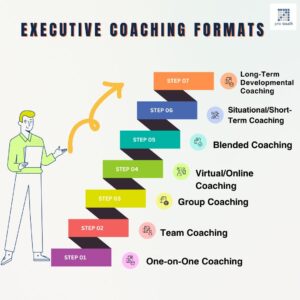
Executive Coaching Formats

Article Banner

Executive Coaching formats refer to the different ways executive coaching is structured and delivered to leaders, depending on their goals, organization needs, and preferred learning styles. The learning style reminded of few courses like Executive coach, ICF coach training or ICF certifications that one can do to enhance your career.

Here are the main Executive Coaching Formats:

1) One-on-One Coaching:

A personalized coaching engagement between a single executive (coachee) and a professional coach. The process is confidential, goal-driven, and tailored to the executive’s unique challenges, leadership style, and aspirations.

  • The most common format.
  • Personalized sessions between the coach and the executive – Executive coach, ICF coach.
  • Focuses on individual leadership goals, performance, and development needs.

Typical Structure

  1. Initial Assessment – Identify strengths, gaps, and goals (may use tools like 360° feedback, psychometrics).
  2. Coaching Agreement – Define scope, duration (commonly 6–12 months), and success measures.
  3. Regular Sessions – 60–90 minutes each, typically biweekly or monthly.
  4. Action & Reflection – Executive applies insights between sessions.
  5. Progress Review – Track outcomes, recalibrate goals if needed.
  6. Closure & Future Plan – Ensure learnings are sustained.

2) Team Coaching:

is a collaborative coaching format where a coach works with an entire leadership or functional team (rather than an individual). The focus is on improving collective performance, communication, alignment, and trust so the team functions at its highest potential.

  • The coach works with an entire leadership team.
  • Helps improve collaboration, communication, and alignment with organizational goals.
  • Builds collective leadership capability.

Typical Structure

  1. Team Assessment – Use surveys, interviews, or tools (e.g., team 360° feedback) to identify strengths and gaps.
  2. Contracting & Goal Setting – Define collective goals, expectations, and measures of success.
  3. Coaching Sessions – Conduct regular team workshops (half-day or full-day), combined with live observation of meetings.
  4. Reflection & Feedback – Team reflects on dynamics, communication, and behaviors.
  5. Action Planning – Apply insights to real business challenges.
  6. Progress Reviews – Track collective improvement, recalibrate if necessary.
  7. Closure & Sustainability – Ensure new habits and culture are embedded.

3) Group Coaching:

involves a coach working with a small group of leaders (often 5–10 participants) at the same time. Unlike team coaching, the members don’t necessarily work together day-to-day. Instead, they come together to learn, share experiences, and grow collectively while still working on individual goals.

  • Several leaders (not necessarily from the same team) coached together in a structured group setting.
  • Encourages peer learning, shared experiences, and networking.

Typical Structure

  1. Participant Selection – Identify a group of leaders with similar development goals or challenges.
  2. Kick-off Session – Establish group norms, trust, and objectives.
  3. Regular Sessions – 90–120 minutes, every 2–4 weeks, facilitated by the ICF coach.
  4. Individual Reflection – Each member applies insights to their own role.
  5. Peer Learning – Members share progress, offer feedback, and support one another.
  6. Closure – Review growth, capture learnings, and set post-coaching commitments.

4) Virtual/Online Coaching:

is delivered through digital platforms (Zoom, MS Teams, Google Meet, or dedicated coaching apps) instead of face-to-face sessions. It provides leaders with the same benefits as traditional coaching but with greater flexibility and accessibility.

  • Conducted through video calls or digital platforms.
  • Flexible, cost-effective, and accessible for global leaders.

Typical Structure

  1. Onboarding & Setup – Agree on platforms, frequency, and confidentiality protocols.
  2. Virtual Assessments – Use digital tools (360° feedback, psychometrics) to set goals.
  3. Regular Coaching Sessions – 60–90 minutes via video call, typically biweekly or monthly.
  4. Between-Session Support – Use chat, email, or apps for reflection and accountability.
  5. Progress Tracking – Online dashboards or check-ins to measure growth.
  6. Closure & Sustainability – Summarize outcomes and provide digital resources for ongoing growth.

5) Blended Coaching:

combines in-person and virtual coaching sessions (and sometimes digital tools, workshops, or group interactions) to provide a flexible and well-rounded development experience. It merges the depth of face-to-face coaching with the convenience of online coaching, often supported by assessments, e-learning, or peer discussions.

  • Combination of in-person and virtual coaching.
  • Often supported by digital tools, assessments, and follow-up check-ins.

Typical Structure

  1. Kickoff (In-Person) – Initial deep-dive session to build trust, set goals, and align expectations.
  2. Regular Virtual Sessions – Biweekly or monthly video sessions for continuity.
  3. Periodic In-Person Check-ins – Quarterly or milestone-based face-to-face sessions.
  4. Digital Learning Tools – Online reflection exercises, coaching apps, or leadership resources.
  5. Progress Tracking – Combination of in-session reflection and digital dashboards.
  6. Closure (In-Person or Virtual) – Review progress, capture learnings, and define next steps.

6) Situational/Short-Term Coaching:

is a focused, time-bound coaching engagement designed to help an executive address a specific challenge, transition, or opportunity. Unlike long-term coaching, it is intensive, targeted, and results-driven, often lasting from a few weeks to 3–6 months.

  • Focused, time-bound coaching to address a specific challenge (e.g., managing conflict, preparing for a promotion, or improving executive presence).

Typical Structure

  1. Rapid Assessment – Quick identification of goals, challenges, and success measures.
  2. Coaching Agreement – Set timeframe, frequency, and focus area.
  3. Intensive Sessions – 45–90 minutes weekly or biweekly.
  4. On-the-Job Application – Executives apply strategies immediately between sessions.
  5. Check-Ins – Brief touchpoints (emails, calls) for accountability and reinforcement.
  6. Closure & Transition – Summarize key learnings and ensure readiness for the future.

7) Long-Term Developmental Coaching:

is a sustained coaching engagement (typically 6–18 months or more) focused on deep, lasting growth in leadership capabilities, mindset, and behaviors. Unlike situational coaching, which solves immediate challenges, this format emphasizes transformational change aligned with both the executive’s career trajectory and organizational goals.

  • Extended engagement (6–12 months or more).
  • Focuses on sustained leadership growth, mindset shifts, and strategic career development.

Typical Structure

  1. Comprehensive Assessment – 360° feedback, psychometrics, interviews to define strengths and growth areas.
  2. Goal Alignment – Co-create long-term goals tied to both individual aspirations and organizational needs.
  3. Regular Coaching Sessions – 60–90 minutes, monthly or biweekly, across 6–18 months.
  4. Action Plans & Reflection – Leaders implement insights between sessions.
  5. Periodic Progress Reviews – Formal check-ins with stakeholders (HR, sponsors, boards if applicable).
  6. Sustainability Practices – Embedding new habits, mentoring others, peer coaching.
  7. Closure & Transition – Review progress, document learnings, and create a roadmap for continued growth.

Conclusion:

Executive coaching comes in multiple formats—from one-on-one, team, and group coaching to virtual, blended, situational/short-term, and long-term developmental coaching. Each format serves a distinct purpose:

The choice of format depends on the leader’s goals, organizational context, time horizon, and resources. When applied thoughtfully, executive coaching is not just a tool for individual growth—it becomes a strategic investment that enhances leadership capacity, drives organizational performance, and builds resilient, future-ready leaders.

Benefits of Executive Coaching

Article Banner

An Executive Coach is a professional who works with leaders, executives, and high-potential professionals to help them enhance their leadership skills, decision-making, self-awareness, and overall performance.

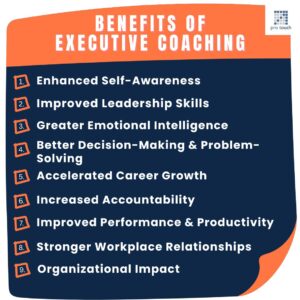
Here’s a structured breakdown of the benefits of Executive Coaching, blending both personal and organizational gains:

1) Enhanced Self-Awareness:

in executive coaching means helping leaders truly understand who they are, how they show up at work, and the impact they have on others. Helps leaders identify strengths, blind spots, and behavioural patterns. Encourages ICF coach training, reflection, leading to better decision-making and leadership presence.

Benefits of Enhanced Self-Awareness for Leaders

  1. Better Decision-Making – Leaders understand how personal biases and emotions influence choices.
  2. Improved Relationships – Recognizing their own communication style helps them adapt to different personalities.
  3. Reduced Blind Spots – Awareness of weaknesses allows leaders to address them proactively.
  4. Stronger Authenticity – Leaders align actions with core values, boosting trust and credibility.

2) Improved Leadership Skills:

in executive coaching refers to developing the core capabilities leaders need to guide teams, drive strategy, and deliver results effectively. Strengthens core competencies such as strategic thinking, communication, delegation, and conflict resolution. Builds the ability to inspire and influence teams effectively.

Benefits of Improved Leadership Skills

  1. Clearer Vision & Strategy – Leaders can set direction and align teams around organizational goals.
  2. Stronger Team Performance – Better delegation, motivation, and support lead to high-performing teams.
  3. Greater Adaptability – Leaders can handle uncertainty, change, and diverse challenges with confidence.
  4. Enhanced Influence – Strong communication and persuasion skills increase their impact across the organization.

3) Greater Emotional Intelligence:

in executive coaching means equipping leaders to recognize, understand, and manage both their own emotions and those of others—leading to stronger relationships, better communication, and more effective leadership. Improves empathy, self-regulation, and interpersonal skills. Enhances the leader’s ability to manage relationships and lead diverse teams.

Benefits of Greater Emotional Intelligence

  1. Improved Collaboration – Builds trust and fosters a positive team culture.
  2. Better Conflict Management – Leaders can resolve disputes with tact and fairness.
  3. Increased Employee Engagement – Leaders who connect emotionally inspire loyalty and motivation.
  4. Resilience Under Pressure – Emotional balance helps leaders navigate crises without losing focus.

4) Better Decision-Making & Problem-Solving:

in executive coaching focuses on sharpening a leader’s ability to evaluate situations objectively, weigh options effectively, and choose the best course of action—especially under pressure. Encourages clarity of thought under pressure. Equips leaders with tools to evaluate complex situations objectively. ICF Certification, ICF coach training and Executive coaching will help in decision-making.

Benefits of Better Decision-Making & Problem-Solving

  1. Faster, More Confident Choices – Reduced second-guessing and hesitation.
  2. Better Risk Management – Anticipate potential obstacles and plan accordingly.
  3. Increased Innovation – Ability to explore unconventional solutions without fear of failure.
  4. Higher Team Trust – Transparent, well-reasoned decisions build credibility.

5) Accelerated Career Growth:

in executive coaching means helping leaders advance more quickly and effectively by equipping them with the skills, confidence, and visibility needed for higher-level opportunities. Prepares leaders for higher responsibilities and succession planning. Builds confidence to take on challenging roles and initiatives.

Benefits of Accelerated Career Growth

  1. Faster Promotions – Targeted skill-building positions leaders for the next level sooner.
  2. Broader Influence – Expands reach and credibility within the organization and industry.
  3. Greater Role Readiness – Leader’s step into new responsibilities with confidence and competence.
  4. Long-Term Career Sustainability – Skills developed remain relevant across roles and industries.

6) Increased Accountability:

in executive coaching means creating a structured environment where leaders consistently follow through on commitments, track progress, and take ownership of results. Regular check-ins and goal tracking keep leaders focused and committed. Executive coaching, ICF certification and ICF coach training encourages taking ownership of outcomes.

Benefits of Increased Accountability

  1. Consistent Progress – Leaders stay on track and avoid procrastination.
  2. Greater Ownership – Builds a mindset of responsibility for both successes and setbacks.
  3. Higher Performance Standards – Encourages continuous improvement and excellence.
  4. Organizational Trust – Teams and stakeholders gain confidence in a leader’s reliability.

7) Improved Performance & Productivity:

in executive coaching focuses on helping leaders maximize their effectiveness, streamline their efforts, and deliver stronger results—both individually and through their teams. Aligns personal goals with organizational objectives for maximum impact. Removes barriers to efficiency through better prioritization and delegation.

Benefits of Improved Performance & Productivity

  1. Higher Output Quality – Leaders produce work that is both faster and more impactful.
  2. Better Use of Resources – Time, energy, and talent are allocated more efficiently.
  3. Stronger Team Results – A more organized and focused leader inspires the same in their teams.
  4. Sustainable Success – Productivity gains are maintained without overwork or burnout.

8) Stronger Workplace Relationships:

in executive coaching means enabling leaders to build trust, foster collaboration, and create a positive environment where people feel valued and respected. Builds trust and collaboration within teams. Enhances cross-functional communication and influence.

Benefits of Stronger Workplace Relationships

  1. Higher Team Engagement – People are more motivated when they feel connected to their leader.
  2. Increased Collaboration – Teams work together more effectively toward shared goals.
  3. Reduced Workplace Friction – Conflicts are resolved before they escalate.
  4. Positive Work Culture – Mutual respect and trust create a healthy, supportive environment.

9) Organizational Impact:

in executive coaching refers to the broad, long-term benefits that extend beyond individual leaders—transforming team performance, company culture, and overall business outcomes. Creates a ripple effect—better leadership leads to more engaged, high-performing teams. Supports talent retention and succession readiness.

Benefits of Organizational Impact

  1. Higher Overall Performance – Strong leadership translates into improved productivity and results across the board.
  2. Greater Agility – Organizations adapt more quickly to change and uncertainty.
  3. Sustainable Growth – Leadership improvements have lasting effects on business success.
  4. Positive Reputation – A well-led organization attracts investors, customers, and top talent.

Benefits of Executive Coaching

Conclusion

Executive coaching is far more than a personal development tool—it’s a strategic investment that elevates both individual leaders and the organizations they serve. By fostering self-awareness, sharpening leadership skills, enhancing emotional intelligence, and driving accountability, coaching empowers leaders to perform at their highest potential. The ripple effect extends to stronger teams, improved workplace culture, and measurable business results. In today’s fast-changing environment, organizations that invest in executive coaching are not just developing better leaders—they’re building a stronger, more resilient future.

Who is Executive Coaching For ?

Article Banner

Executive coaching is for Individuals in Leadership or high-responsibility roles who want to improve their effectiveness, decision-making, and impact. In short—executive coaching is not just for those at the very top; it’s for anyone in a leadership position who needs a structured, confidential space to grow, reflect, and perform at their best.

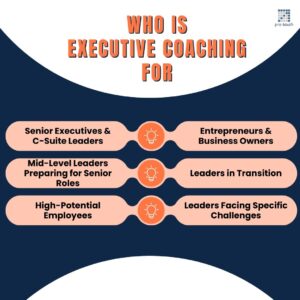
It’s most commonly aimed at:

executive coaching

a. Senior Executives & C-Suite Leaders:

benefit from executive coaching, ICF Certification, ICF coach training because they operate at the highest strategic level, where the stakes are high, decisions are complex, and isolation can be a real challenge. CEOs, CFOs, COOs, and other top-level leaders who need to navigate complex challenges, drive strategy, and inspire teams. Common Coaching Goals for this group: Strategic Clarity – refining vision, mission, and long-term direction. Executive Presence – building credibility, influence, and gravitas. Decision-Making Under Pressure – balancing speed with thorough analysis. Leading Organizational Change – guiding teams through transformation with minimal disruption. Stakeholder Management – navigating boards, investors, and senior peers effectively. Work–Life Integration – preventing burnout and sustaining energy over the long term.


b. Mid-Level Leaders Preparing for Senior Roles:

are often in the “stepping stone” stage — they’ve proven themselves in operational or functional leadership, but now need to develop the vision, influence, and strategic mindset required at the executive level. Managers or directors on the path to executive positions who need to sharpen leadership, communication, and strategic thinking skills with the help of Executive coaching, ICF Certification and ICF coach training. Common Coaching Goals for this group: Strategic Thinking – shifting focus from daily operations to big-picture impact. Cross-Functional Influence – collaborating beyond their department to drive enterprise-wide initiatives. Leadership Presence – strengthening communication, confidence, and credibility with senior stakeholders. Change Leadership – learning to guide teams through uncertainty and transformation. Decision-Making Maturity – balancing risks, resources, and long-term outcomes. Self-Management – managing stress, setting boundaries, and avoiding burnout as responsibilities grow.


c. High-Potential Employees (“HiPos”):

are individuals identified by the organization as having the capability, ambition, and readiness to take on significantly greater leadership responsibilities in the near future. They’re often groomed for senior roles through targeted development programs, with executive coaching as a core component. Rising stars identified by the organization for future leadership roles, often receiving coaching as part of succession planning. Common Coaching Goals for HiPos: Accelerated Leadership Development – building advanced skills faster to prepare for bigger roles. Broader Business Acumen – understanding strategy, finance, and cross-functional dynamics. Self-Awareness & Emotional Intelligence – recognizing strengths, addressing blind spots, and managing relationships effectively. Influence Without Authority – learning to lead peers and senior stakeholders without formal power. Confidence in Ambiguity – making decisions and taking initiative in uncertain environments. Career Path Planning – clarifying long-term aspirations and aligning them with organizational needs.


d. Entrepreneurs & Business Owners:

often wear multiple hats — strategist, operator, marketer, and problem-solver — all while carrying the weight of business survival and growth. Executive coaching gives them a structured space to step back, think strategically, and lead more effectively. Founders seeking clarity, better delegation, or strategies for scaling without burnout. Common Coaching Goals for Entrepreneurs & Business Owners: Vision & Growth Strategy – clarifying long-term direction and scaling sustainably. Delegation & Team Building – shifting from “doing everything” to empowering capable teams. Decision-Making Clarity – balancing gut instinct with data-driven choices. Time & Energy Management – preventing burnout while staying productive. Leadership Brand – shaping how they’re perceived by employees, investors, and partners. Adaptability – navigating rapid market changes and uncertainty.


e. Leaders in Transition:

are individuals stepping into a new role, environment, or phase of leadership — situations where expectations are high, uncertainty is high, and the margin for error can be small. Executives taking on a new role, entering a new market, or leading through mergers, acquisitions, or restructuring. Common Coaching Goals for Leaders in Transition: First 90-Day Strategy – creating an impactful entry plan to establish credibility quickly. Cultural Adaptation – understanding and aligning with a new organizational or market culture. Stakeholder Alignment – building strong relationships with boards, peers, and key influencers early on. Role Clarity – defining priorities and boundaries in a new scope of responsibility. Change Navigation – leading teams smoothly through restructures, mergers, or pivots. Confidence & Resilience – managing the stress and ambiguity that comes with change.


f. Leaders Facing Specific Challenges:

are individuals whose performance or impact is being affected by a defined set of issues — often urgent, complex, or highly visible — that require targeted development and problem-solving. Those struggling with team alignment, communication breakdowns, decision fatigue, or organizational politics. Common Coaching Goals for this group: Conflict Resolution – addressing tensions with peers, teams, or stakeholders constructively. Team Alignment – rebuilding trust, collaboration, and morale. Performance Turnaround – overcoming declining results or stalled initiatives. Decision Fatigue Management – streamlining priorities to avoid burnout and indecision. Political Savvy – navigating organizational dynamics without damaging integrity. Communication Reset – improving clarity, listening skills, and message impact.

Conclusion

Executive coaching is not a “one-size-fits-all” tool — it’s a personalized development partnership designed to meet leaders exactly where they are. Whether it’s C-Suite executives refining their vision, mid-level leaders preparing for bigger roles, high-potential employees accelerating their growth, entrepreneurs building sustainable businesses, leaders navigating transitions, or those facing specific challenges, coaching provides a confidential, structured space to think, adapt, and lead with greater clarity and confidence.

Ultimately, executive coaching equips leaders to not only perform better but also to lead with impact, ensuring that both they and their organizations thrive in complex, fast-changing environments.