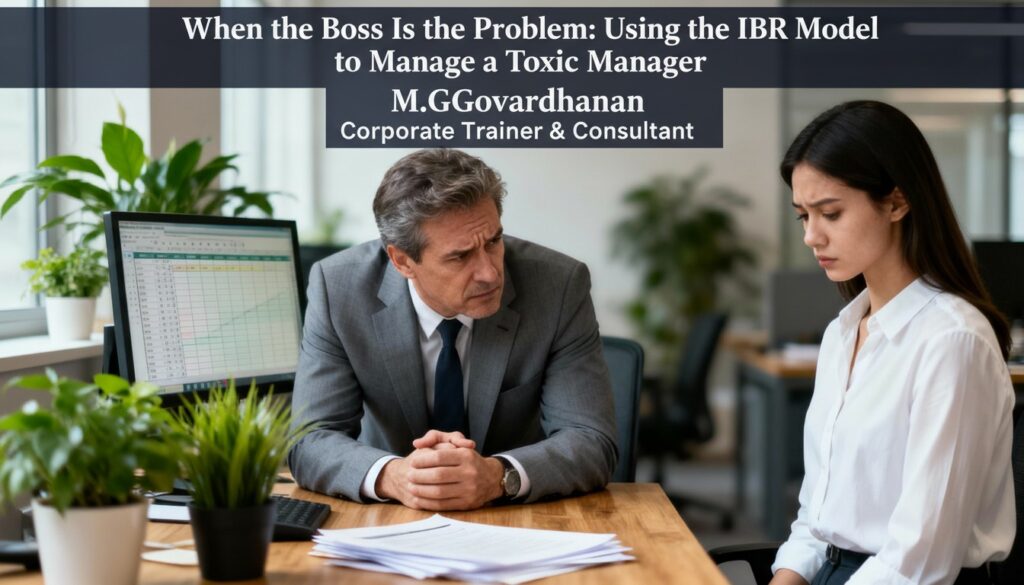

Conflict at the workplace is not unusual, but when it involves a toxic boss, it becomes emotionally draining and professionally risky. Many employees silently endure challenging behaviour—constant criticism, unpredictable anger, micromanagement, or public humiliation—because they fear consequences.
The best way to handle this situation is not confrontation, avoidance, or emotional reaction. It is using a structured conversation approach that reduces defensiveness, protects your dignity, and focuses on joint problem-solving. This is where the Interest-Based Relational (IBR) Model, developed by Fisher & Ury of the Harvard Negotiation Project, becomes invaluable.
The IBR model helps you approach difficult conversations with maturity and strategic clarity, even when power dynamics are unequal.
Understanding the IBR Model
The IBR Model rests on three key principles:
- Separate the people from the problem
Do not attack the boss personally—focus on the behaviour.
- Focus on interests, not positions
Find the real motivations behind your boss’s actions.
- Work together to find options
Shape the conversation as a joint problem-solving exercise.
For conflicts with managers, these principles create psychological safety and reduce the chances of escalation.

Applying the IBR Model with a Toxic Boss
Below is a practical 6-step guide on using the IBR model in real workplace situations.
Step 1: Prepare Yourself Emotionally
Before you speak, prepare.
Toxic behaviour triggers emotional reactions, but the conversation must come from calmness, not frustration.
Prepare by:
- Listing facts, not interpretations
- Identifying what outcome you want
- Choosing neutral examples
- Practising your tone and body language
The goal is to enter the conversation professionally and with balance, not anger.
Step 2: Create a Safe Opening
A toxic boss may respond defensively if they sense confrontation.
Start by creating psychological safety:
- “I value your guidance.”
- “I want to discuss something that can help me perform better.”
- “Can we have 10 minutes to align on expectations?”
This framing shows respect and reduces perceived threat.
Step 3: Separate the Behaviour from the Person
Do not begin with accusations like:
“You humiliate me in front of others.”
“You don’t respect my work.”
This triggers ego and shuts down communication.
Instead, use behaviour-based, neutral statements:
- “In yesterday’s meeting, feedback was given publicly.”
- “The deadlines changed several times last week.”
- “I noticed instructions shifting mid-task.”
This keeps the conversation objective and focused.
Step 4: Understand the Boss’s Interests
Toxic behaviour usually hides deeper interests:
| Behaviour |
Possible Interest |
| Micromanagement | Fear of mistakes or pressure from their boss |
| Anger | Stress, overload, unrealistic targets |
| Credit-taking | Insecurity or desire for recognition |
| Unclear directions | Time pressure or decision fatigue |
Acknowledging their interest can immediately reduce tension:
- “I understand timely delivery is important to you.”
- “Accuracy is clearly a priority for our team.”
This signals empathy—not agreement—and opens the door for dialogue.
Step 5: State Your Interests Calmly
Once their interest is acknowledged, express your own:
- “I need clarity so I can deliver high-quality work.”
- “Private feedback helps me improve better than public criticism.”
- “If I know priorities upfront, I can reduce rework.”
This is not complaining.
This is professional self-advocacy, done respectfully.
Step 6: Jointly Create Options
Now shift the conversation to solutions using collaborative language:
- “Would weekly priorities help both of us stay aligned?”
- “Can we finalise requirements before execution?”
- “Would daily updates reduce the need for frequent follow-ups?”
When framed as joint options, your boss is more likely to agree.
Close the discussion by aligning on:
- What you will do
- What they will do
- How progress will be reviewed
After the meeting, send a short, polite summary email.
This protects you and reinforces clarity.
What If the Boss Doesn’t Change?
Some toxic behaviors are deeply ingrained. If things do not improve:
- Keep documenting incidents objectively
- Speak confidentially to HR
- Request mediation
- In extreme cases, consider internal transfer
Escalation is not rebellion. It is safeguarding your well-being and performance.

Why the IBR Model Works So Well with Toxic Managers
- Reduces defensiveness
- Maintains professionalism
- Protects the relationship
- Keeps the focus on shared goals
- Helps employees speak up safely
- Allows constructive escalation if needed
- Preserves dignity on both sides
Most importantly, the IBR model helps you remain emotionally grounded in a situation where the power balance is uneven.
Conclusion: Difficult Conversations Are Leadership Moments
Managing a toxic boss does not mean “fighting back.”
It means handling the situation strategically, sensitively, and professionally.
Using the IBR model, you transform emotional conflict into a structured conversation that protects your dignity, builds clarity, and strengthens the possibility of healthier boundaries.
This is not just conflict management—it is personal leadership.