
The Ardent Need For Developing Soft Skills at Workplace

The Ardent Need For Developing Soft Skills at Workplaces

Soft skills are an amalgamation of people skills, communication skills, and social intelligence. The term “soft skills” usually used for non-technical skills that have a direct connection with the way one works. They include how you interact with colleagues, how you solve problems, and how you manage your work, interpersonal skills or emotional intelligence quotient. On the other hand, hard skills, describe an individual’s ability to perform a particular task technically. As a matter of fact, soft skills apply across designations and businesses. With hard skills one may crack an interview, but to successfully carry out the job, one would need soft skills; thereby bring out the vital significance of soft skill development.
Soft Skills at Workplaces
I would like to suggest some soft skills that would be pivotal in coping with the stress and work-pressures of the workplace or hospital.

Adaptability
Adaptability refers to the ability to cope up with change. You will not be intimidated if you are adaptable to any new work environment, for that matter new software, or a new client, new challenge for that matter, or anything unfamiliar even a situation for that matter, as the circumstance will demand your analytical skills coupled with observational skills, which would help you to adapt to the situation, work place, location, or matter, efficiently.

Team Man
Teams are often identified for their collaboration and teamwork in their high performances. It only stands to reason that employees must imperatively learn to understand and perceive a perspective correctly, and incorporate the same in their skills repertoire, and be receptive to proper and genuine criticism and feedback, and be able to delegate and monitor tasks effectively. In other words, soft skill is the pivot around which a healthy team dynamic revolves.

Hearing, Comprehension and Listening
Successfully developing soft skills entirely depends upon this aspect. Listening is not as lucid as it appears to sound.  Surely you must have had met disturbance mongers or interrupters. You will know it’s not a pleasant experience in their presence; it can make you feel neglected, unwanted, and not important. On the other hand, someone who doesn’t interrupt and lets you finish proves themselves to be more approachable and understanding. This forms an important quality, for those in leadership roles.

(EQ) quotient or Emotional Intelligence
Emotional Intelligence revolves around your ability to handle your emotions and those of the people around you. It is well known that an employee with low levels of EQ could blatantly criticize or ridicule a team member / peer or senior or junior colleague during a meeting or event.  Where as a person / employee possessing high-EQ would share his criticism / suggestions privately, and thereby save face of their colleague.

Imbibing and horning of soft skills has become essential at workplaces. Employees who possess these skills tend to become natural leaders in life be it in workplace or anywhere. These persons are highly efficient, particularly in tasks where they have to co-ordinate and collaborate with peers, seniors & juniors and / or other team members.

soft skills
One may ask what the best ways to teach Corporate Soft Skills are or how to Train Employees on Soft Skills, I would suggest the following doable:-

Call in for a Professional Soft Skills Trainer

Conceptualise tailor made modules and Conduct Live Interactive Workshops

Create a conducive Learning Environment, followed by refresher learning modules at later stages. 

Opting for eLearning modules or blended training is certainly proving helpful.

The companies do not opt for training may save cost now and will pay high cost in future. Investing in employee’s skills is not an cost. Every company msut invest in employee’s development.

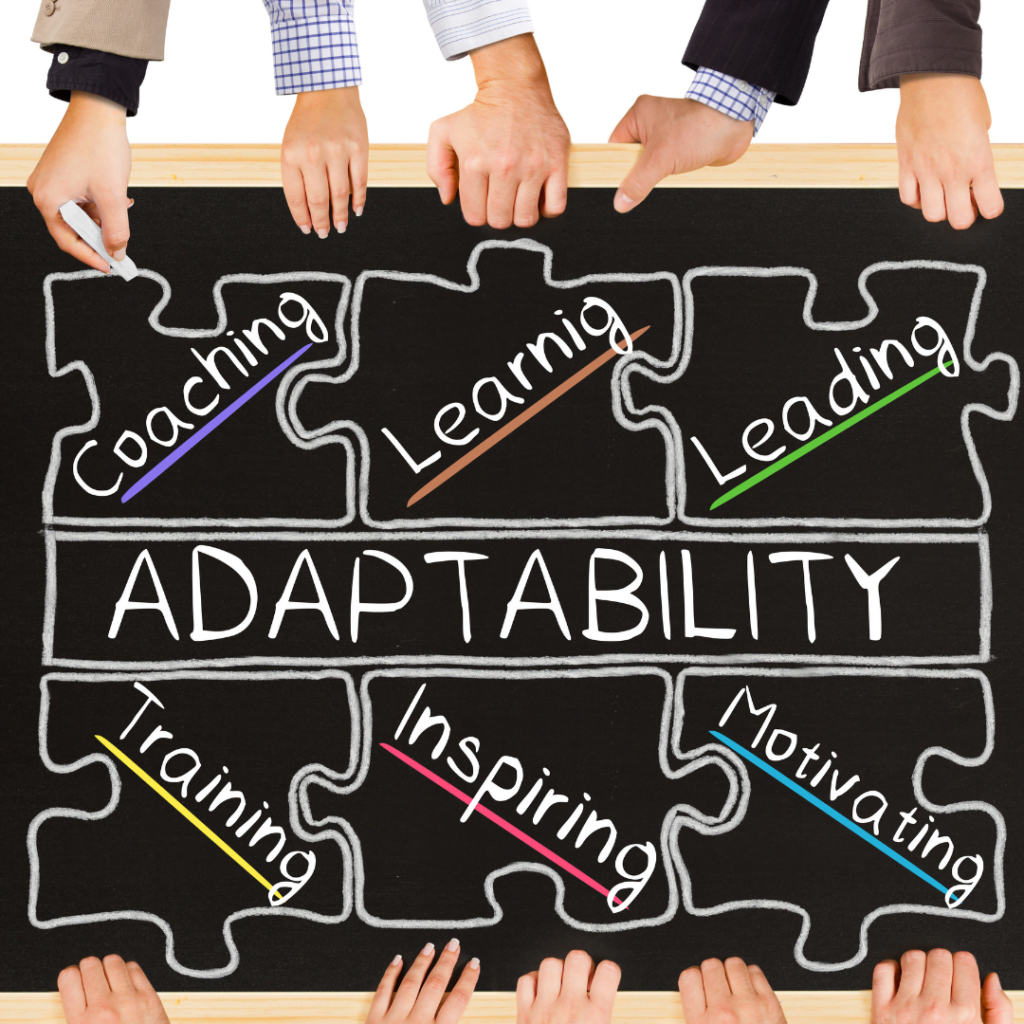
Adaptability in Workplace – Soft Skill Training is a Way Forward

Adaptability in Workplace - Soft Skill Training is a way forward

Providing employees with relevant and consistent soft skill training can help improve workplace performance and efficiency.

Adaptability in Workplace.

Adaptability is the ability to learn new things; it is the art of being the flexible and accepting change. It is the potential to adjust to changing factors, conditions, and environments. It is a widely acceptable soft skill by all employers because the languishing challenge in business and industry is changing environment and emerging new technology.

Adaptability in the workplace is the ability to spindle by learning new skills and behaviour per the command of changing environment. The ability to adopt is slightly different and very much depends upon the workplace, environment, and individual’s specific role.

Adaptability in Workplace
The ability to adapt is different from the ability to manage change; managing change is preparing the workforce. Engage shareholders, transition change, manage risk, and improve performance. Adaptability is a soft skill which is much more in demand. It is a skill which shows how employees reacts in unplanned and involves rapid adjustment concerning changing situations. 

Adaptable employees will be able to shift strategy quickly and effectively, finding alternative solutions that have not been anticipated in advance. Employees should be innovative, quick learners with the attitude to accept and adopt the change.

A fable from childhood called “The Oak and The Willow” tells the story of two trees as the weather changes. As the tale goes, a tan oak tree and a willow tree stood in the same field. A windstorm broke the oak tree one day while the willow stood firm. When the wind blew, the willow would blow every way while the oak tree stood tall. This caused great distress to the willow, who lamented his inability to stay as strong as the oak. The willow tree’s adaptive nature allowed it to bend with the winds of change, while the rigid oak suffered a cruel fate.

Though just a story, this fable illustrates a principle that’s also important in business i.e. the ability be adaptive.

Employer Role Towards Adaptation

The employer also plays a vital role in supporting the workforce to adapt to the change. They can create a learning environment by providing soft skill training. Employers should be involved in creating a new ecosystem with the required infrastructure, introducing the courses for up-skilling employees, and measuring and mentioning feedback regularly as per the requirement.

Skills Required For Adaptation 

Adaptation for change is quite challenging. It is mainly required to maintain a competitive edge in the business world, and employees should inbound the following skills to respond effectively to changes:

Accepting the changes and adopting the changes 

Effective problem solving

Exchanging of thoughts and knowledge

Acquiring required new skills.

Work together as a team.

Setting the goal and staying motivated.

Work under pressure

Fit to the culture

Importance of Adaptability

Adaptability is essential for constant business changes. Nothing is a good change. It is only the truth that should be acceptable for survival. Adaptability showcases the ability to be resourceful, displays leadership skills, and determination skills, and these are valuable adaptable qualities an employer looks for in an employee; both employee and the employer will be more relevant to ongoing changes in technology, current environment, and other fields.
Adaptabilty
Adaptive Readiness.

The first and foremost step for adaptation is to make up your mind to accept the changes and sharpen the skills in the critical area, “Corporate Training plays a crucial role in developing adaptability skill.”

The following factors can be considered at the time of delivering or designing corporate training on adaptability:  

Make up your mind to come out of your comfort zone.

Developing listening ability.

Thinking out of the box.

Adoption of positive thinking

Open up to learn from coworkers.

Be a good team player.

Practice emotional intelligence.

Fixing up the goal.

Benefits of Adaptability Training: 

Adaptability training to a workplace is beneficial for both employees and employers.

Employees develops adaptable nature and become more valuable employees and adds value to the organization.

Employees with a learning attitude for adopting themselves in the workplace also develops leadership skills and lead the organization on the right path.

Employees becomes better equipped to face challenges and will enjoy career growth.

Adapatability corporate training makes the ready workforce for employers. 

Conclusion:

It is crucial to provide corporate training on adaptability. The important role of soft skill training towards adaptability. Providing employees with relevant and consistent soft skill training can help improve workplace performance and efficiency. It creates an opportunity for employees to enhance their knowledge impacting productivity, moral values, and commitment towards the work despite the cost of corporate training for employers. The return on investment on corporate training session on soft skill is enormous if it is constant.

Top 7 Reasons To Conduct Posh Training At The Workplace

Top 7 Reasons To Conduct Posh Training At The Workplace

POSH training for employees is essential to make employees aware of the law and the consequences of violations in the organization.

Prevention of Sexual Harassment (POSH) is a law that falls under the POSH Act, of 2013. POSH – the word itself says “prevention” – of sexual harassment at the workplace. The POSH Act prevents and protects women at the workplace against sexual harassment. It also includes the provision of redressal against violation. As per law, it is applicable for Women at the workplace, but the company can consist of all employees, either full-time or on contract in the policy.

POSH Training for Employees
Organizing POSH training in an organization, fosters better relationships and equality among employees, thus ensuring a quality workplace environment for all its employees.

POSH training is a method used by organizations to educate their employees on sexual harassment of women at the workplace and create awareness of all that it has included under it. 

The POSH awareness training also throws light on the redressal mechanism one should take in case of any incident with themselves or their colleagues. On-time movement avoids legal complications and also helps maintain a healthy work environment in the company.

POSH Training
Importance of POSH training

  1. POSH training is essential to make employees aware of the law and the consequences of violations in the organization. Therefore, the training has to be organized not only for women but also for men. Knowing what comes under sexual harassment, what can come under fake complaints, and how to make the correct use of the law and prohibit misuse; ensures a safe working environment for women and helps maintain equality at the workplace. 
  2. Sometimes, a woman is not clear whether a particular incident is included under sexual harassment or not. Sometimes, colleagues who want to help are not clear on the law. POSH awareness training is critical in any organization to protect women’s rights and maintain a high-quality work environment for success and growth. With this, employees feel free to engage, interact, and coordinate with each other since they feel safer. People also have a higher level of job satisfaction, which helps in employee retention. This increases productivity at work. 
  3. The POSH training is essential because it gives employers and employees an insight into what sexual harassment is and how to differentiate it from other non-sexual harassment cases. It prevents someone from being wrongly accused. 
  4. Women often do not report the matter because they fear losing their livelihood, their personal and professional reputation and being stigmatized. Several employees might hesitate to report such cases as they feel it would be ineffective and result in losing their jobs. But POSH teaches how these situations can be dealt with proper measures. 
  5. POSH training ensures prevention, prohibition and protection against sexual harassment at the workplace. POSH awareness training can save the company from legal complexities. 
  6. A case against sexual harassment at the workplace can also damage the company’s image among its existing and prospective customers. In addition, it can also cause mental and monetary disruption to the employer. Hence, it is crucial to have timely POSH training for employees to safeguard the company’s reputation. 
  7. POSH training boost morale among employees and educate the management to comply. Furthermore, it brings about better coordination between the employees, management, and fellow employees. All these factors provide a comfortable environment to work, promoting a positive work culture.

Employers can avoid financial and legal liabilities by arranging regular and effective sexual harassment prevention training provided by expert HR Services. POSH Training for employees ensures HR Compliance while educating and empowering employees. Moreover, it can in develop a better organizational culture wherein everyone understands the expected and accepted behaviour.