
Feedback is not a “nice-to-have”; it is the bloodstream of any high-performing team. When we learn the art of giving feedback, we stop firefighting behavior and start architecting culture.
And yet, most of us either sugarcoat it to the point of uselessness or deliver it so harshly that the message gets lost in bruised egos. I believe feedback is an art form — one that sits right at the intersection of emotional intelligence and leadership maturity . When done right, it doesn’t just correct behavior, it elevates performance. A study conducted by Harvard Business Review reveals that organizations with strong feedback cultures experience 14.9% lower employee turnover, proving how powerful effective feedback is in retaining talent.
Let’s talk about two powerful frameworks that turn awkward conversations into growth-driven dialogues: the SBI Model and the Feedback Sandwich .
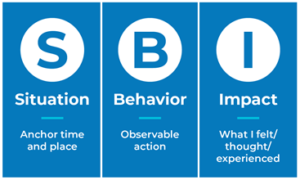
The SBI Model (Situation–Behavior–Impact) is beautifully clinical in its precision. Imagine this scenario: your team member, Ronit, consistently interrupts clients during meetings. Instead of saying, “You’re very rude in meetings,” you anchor your feedback in facts. You say, “In yesterday’s client review meeting (Situation), you interrupted the client multiple times while she was explaining her requirements (Behavior), and that made the client look uncomfortable and may impact our professional image (Impact).” See the difference? There’s no judgment, no drama — just clarity . SBI removes emotion from the accusation and injects objectivity into the conversation. It’s professional, respectful, and almost impossible to argue with. In the MindTools’ description of the SBI Feedback Tool, which emphasizes that structuring feedback around SBI makes messages clearer, more direct and less prone to misunderstanding, so people experience it as more helpful and less threatening.
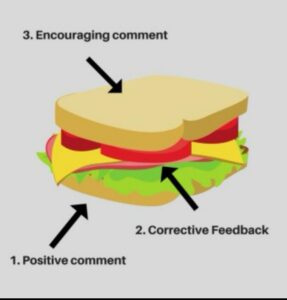
Now let’s move to the Feedback Sandwich , a classic technique that, when used with sincerity, works like magic ✨. Picture this: your team member, Shanaya, submits a report that is structured well but filled with data errors. You begin with genuine appreciation: “I really like how you structured the report; it was easy to follow.” Then you layer in the real issue: “However, I noticed several data inaccuracies that could affect decision-making.” And you close on an empowering note: “I know your attention to detail is strong —a quick recheck next time will make your work exceptional.” This method cushions the blow, preserves dignity, and keeps motivation intact . But a word of caution — the praise must be real, or people will see right through the performance

Now, here’s where most people sabotage their own feedback — the language they choose . This is where “I-messages” and “You-messages” come into play. A “You-message” sounds like an attack: “You are always late. You don’t care. You are careless.” It blames, shames, and puts the other person on instant defence mode . An “I-message” is emotionally intelligent and ownership-driven: “I feel concerned when meetings start late because it affects the team’s productivity.” Same issue, completely different energy. One builds walls, the other builds bridges . Feedback is not about proving you’re right; it’s about helping someone do better .Psychologist Thomas Gordon popularized I-messages in his work on parent–child and leadership communication, arguing that they reduce resistance and invite collaboration rather than counter‑attack. As Steven J. Fogel later summarized, I-messages report how you feel; You-messages claim the other person “made” you feel that way. That distinction is tiny in grammar and massive in psychology
Crafting your feedback signature- Ultimately, methods are scaffolding, not scripts. The real art lies in aligning three things: your intention (to support growth, not punish), your language (I‑messages over You‑attacks), and your structure (SBI or sandwich, chosen consciously). Over time, this becomes your feedback signature — firm, fair, and deeply human.
To sum up, until some AI finally manages to read our minds, we will have to keep doing the courageous, imperfect human job of giving feedback out loud. Put these ideas into practice and craft spaces of radical candor and trust, so that together we normalize a culture where feedback is not a threat, but a shared act of leadership.