
This question often features in popular discussions within psychology and closely resembles the long-standing debate of nature versus nurture. As a trainer, I would like to believe that people can be trained in almost everything—I say almost because some aspects come naturally to individuals, some are passed on genetically, and others are acquired through vicarious learning.
While the world has long focused on teaching and improving IQ, I see a refreshing shift today. Start-ups and institutions are increasingly focusing on teaching Emotional Intelligence (EQ), especially to children, recognising it as a foundational life skill best developed at an early age.
Let us first understand what emotional intelligence really means. Much has already been written on this subject, so instead of defining it formally, I would like to put it simply:
- IQ may help you get an interview, but EQ helps you land the job.
- IQ may attract clients, but EQ helps you retain them.
- IQ may assist in matchmaking, but EQ contributes to a successful marriage.
- IQ may get you a position, but EQ helps you command the respect that position deserves.
The list can go on.
The importance and scope of emotional intelligence span across couples, parenthood, relationships, and organisations. The term has become so prevalent that even those who may not fully understand its definition can still recognise it as the X-factor in someone’s personality.
How often have you heard someone say, “This person has just joined our office, yet people are instantly drawn to them—there’s something about them”?
That something, my friends, is emotional intelligence.
Such individuals are self-aware of their emotions and emotional needs, which enables them to understand others better. Emotional intelligence truly acts like the icing on the cake—or better still, the cherry on top.
With so many benefits, why wouldn’t individuals or organisations want emotionally intelligent employees?
This brings me back to the core question: Can emotional intelligence be taught?
My answer is absolutely yes.
Can one see a difference in themselves, their output, and performance? Possibly—with consistent practice.
Will a person become emotionally intelligent in every aspect of life? That is harder to say. It largely depends on whether the individual is mindful enough to apply what is learned in one or two sessions across various life situations.
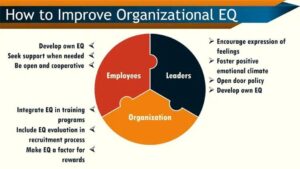
Tools That Help Develop Emotional Intelligence
Some practical and widely used methods include:
- Emotional journaling
- Mindfulness and meditation
- MSCEIT (Mayer-Salovey-Caruso Emotional Intelligence Test), a scientifically validated, ability-based assessment
- Active listening and role-playing for empathy development
- 360-degree feedback for objective insight
- Stress management techniques
What Research Says
Research strongly supports the trainability of emotional intelligence.
A study by Vesely, Saklofske, and Nordstokke (2014) involved a five-week training programme for undergraduate teacher candidates in Canada. Participants received 1.5 hours of EI training per week through workshops, discussions, exercises, and assignments. The results showed a significantly greater improvement in EI compared to the control group.
Another study by Al-Faouri, Al-Ali, and Al-Shorman (2014) delivered EI training to nurses over seven weeks and found improvements not only in emotional intelligence scores but also in job satisfaction.
(Data referenced from the ScienceDirect article: “Can Emotional Intelligence Be Trained? A Meta-Analytical Investigation” by Victoria Mattingly and Kurt Kraiger.)
Instead of speaking only in terms of research and large datasets, I would like to bring this closer to home—as a mother.
Raising an 11-year-old daughter who changes schools every two years due to her father’s profession, I once heard her say:
“Mumma, there is a new kid who came to play today and no one spoke to him. I knew how he must be feeling because I was once new too. All I ever wanted then was for someone to come and talk to me.”
That moment filled me with pride and joy. It reaffirmed my belief that years of teaching her to step into someone else’s shoes had truly paid off.