
Introduction
Every workplace has an invisible rhythm. It is not written in job descriptions or displayed on office walls, yet it decides whether an organization thrives or struggles. This rhythm is communication—the continuous flow of ideas, emotions, instructions, and feedback between people who share a common goal.
Imagine a workplace where no one truly listens, where messages are unclear, and where every instruction is misunderstood. Now imagine another where conversations are clear, listening is active, and ideas move smoothly from one person to another. The difference between these two workplaces is not talent or resources—it is interpersonal communication.
In the modern business environment, communication is no longer just a supporting skill. It is the foundation upon which collaboration, leadership, innovation, and success are built. It is the bridge that connects individuals into teams and teams into organizations.
The Heartbeat of the Workplace
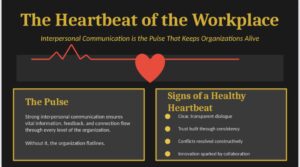
Interpersonal communication is the exchange of thoughts, ideas, emotions, and information between individuals. In a workplace, it becomes the heartbeat that keeps operations alive and moving. Every email sent, every meeting conducted, every discussion held in the hallway contributes to this ongoing flow of connection.
Strong communication transforms a workplace into a coordinated system where people understand not only their tasks but also their purpose. When employees communicate effectively, they do not work in isolation—they work in harmony. Ideas are shared freely, confusion is reduced, and collaboration becomes natural rather than forced.
Leadership, in particular, depends heavily on communication. A leader’s words can shape direction, but their communication style shapes trust. A well-communicated vision can inspire an entire organization, while unclear messaging can lead to uncertainty and disengagement. Great leaders understand that communication is not about speaking more—it is about speaking meaningfully and listening deeply.
Forms That Shape Understanding
Interpersonal communication in business takes many forms, each adding its own dimension to workplace interaction.
Verbal communication is the most direct form. Meetings, discussions, presentations, and conversations allow ideas to be exchanged instantly. The tone of voice, clarity of expression, and confidence in speech all influence how messages are received and interpreted.
Written communication builds structure and permanence. Emails, reports, proposals, and digital messages ensure that information is recorded and shared across time and teams. In today’s digital workplaces, writing has become a reflection of professionalism and clarity of thought.
Nonverbal communication often speaks in silence. A nod of agreement, eye contact during a conversation, or even posture during a meeting can reinforce or weaken spoken words. Sometimes, what is not said carries more meaning than words themselves.
Active listening is the silent strength behind all communication. It is the ability to fully focus on the speaker, understand their message, and respond thoughtfully. Listening is not passive—it is an active effort to understand before responding. In many workplaces, good listeners become natural problem-solvers and trusted team members.
Challenges in Communication Flow
Even in well-structured organizations, communication is not always smooth. Several barriers can disrupt understanding and create distance between people.
Miscommunication often arises when messages are unclear or incomplete. Cultural and language differences can further complicate interpretation in diverse workplaces. Emotional stress may also distort communication, leading to reactive or defensive responses instead of thoughtful dialogue.
In today’s fast-paced digital world, information overload is another major challenge. Employees receive constant emails, notifications, and updates, making it easy for important messages to be overlooked. Additionally, overreliance on digital tools sometimes reduces face-to-face interaction, weakening personal connection and emotional understanding.
These barriers do not just slow down work—they affect relationships, trust, and workplace morale.
Building Strong Communication Skills
Improving interpersonal communication requires conscious effort and consistent practice.
One of the most powerful habits is active listening. When individuals listen with full attention, they show respect and build trust. It also ensures fewer misunderstandings and better decision-making.
Clarity in expression is equally important. Communication should be simple, direct, and free from unnecessary complexity. Clear messages save time and increase efficiency.
Developing emotional intelligence plays a vital role in communication. Understanding one’s own emotions and recognizing the feelings of others helps individuals respond with empathy and patience rather than frustration or misunderstanding.
Another important element is feedback culture. Constructive feedback helps individuals grow and improves overall performance. When feedback flows openly, communication becomes a tool for development rather than criticism.
Finally, adaptability ensures communication success across different situations. A professional must know when to be formal, when to be collaborative, and when to be persuasive. Each situation demands a different communication style.
The Role in Modern Business Success
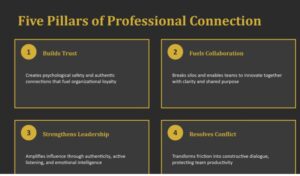
In the modern business environment, communication is the engine that drives productivity and innovation. Teams often work across locations, cultures, and time zones. In such a setting, interpersonal communication becomes even more important because it replaces physical presence with clarity and connection.
Organizations that invest in communication skills experience stronger teamwork, fewer conflicts, and higher employee satisfaction. Employees feel more connected, more valued, and more motivated when communication flows openly and respectfully.
Good communication also strengthens customer relationships, improves decision-making, and builds a positive organizational culture. It turns workplaces into environments where ideas grow and people thrive.
Conclusion
Interpersonal communication is not just a professional ability—it is a human connection skill that defines how people work together. In the workplace and business environment, it shapes leadership, teamwork, productivity, and trust.
When communication flows clearly, workplaces become more than spaces of work—they become spaces of understanding, collaboration, and growth. In the end, organizations do not succeed only because of systems or strategies, but because people communicate in ways that bring those systems and strategies to life.
In every successful business, communication is not just happening it is thriving.