

Soft Skills Training
In today’s fast-paced and highly competitive professional landscape, technical expertise alone is no longer enough. While hard skills may get you hired, it is soft skills that determine how far you grow, lead, and influence.
Soft skills training has emerged as a critical component of personal and professional development.
It focuses on enhancing interpersonal abilities, emotional intelligence, communication, and behavioural competencies that enable individuals to navigate complex workplace dynamics effectively. As workplaces become more collaborative and diverse, the ability to connect, communicate, and adapt is becoming a key measure of professional success.
What Are Soft Skills?
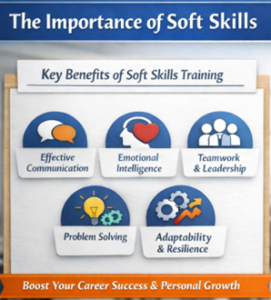
Soft skills are a combination of communication abilities, mindset, emotional intelligence, and social awareness. They include skills such as:
- Effective communication
- Leadership and team collaboration
- Emotional intelligence and empathy
- Problem-solving and decision-making
- Adaptability and resilience
- Time management and accountability
Unlike technical skills, soft skills are not role-specific. They are transferable across industries and functions, making them essential for long-term career success.
They also play a crucial role in how individuals respond to challenges, build relationships, and create opportunities for themselves.
Why Soft Skills Training Matters
Many professionals struggle not because they lack knowledge, but because they struggle to express, manage, or position that knowledge effectively.
Soft skills training bridges this gap.
It helps individuals:
- Communicate their ideas with clarity and confidence
- Build strong professional relationships
- Handle conflicts and feedback constructively
- Lead teams with empathy and influence
- Adapt to change without burnout
In my experience of over three decades in the corporate world, I have seen highly skilled & highly qualified professionals remain unnoticed simply because they lacked visibility, confidence, or assertiveness. On the other hand, those who invested in their soft skills often moved ahead—not just in roles, but in impact.
These skills often act as the invisible force that shapes perception and credibility in the workplace.
The Link Between Soft Skills and Career Growth
Soft skills directly influence key career milestones—promotions, leadership opportunities, and recognition.
For mid-career professionals especially, the challenge is not about learning more technical skills. It is about:
- Being heard in meetings
- Expressing ideas without hesitation
- Managing stress and expectations
- Balancing professional and personal responsibilities
This is where structured soft skills training creates transformation. It enables individuals to move from self-doubt to self-assurance, from burnout to balance, and from confusion to clarity. It also helps professionals build a strong personal brand within their organization.
Soft Skills and Leadership
Leadership today is less about authority and more about influence.
A good leader is not defined by their designation, but by their ability to:
- Listen actively
- Communicate transparently
- Inspire trust
- Manage diverse teams
- Make thoughtful decisions under pressure
These are all outcomes of strong soft skills. Leaders who invest in these abilities create more engaged, motivated, and high-performing teams.
Organizations that invest in soft skills training are not just building employees—they are building future leaders.
Beyond the Workplace
Soft skills are not limited to professional success. They play a vital role in personal life as well.
They improve:
- Relationships and communication at home
- Self-awareness and emotional regulation
- Confidence in decision-making
- Overall mental well-being
In essence, soft skills training supports holistic growth. It helps individuals lead more balanced, fulfilling, and purpose-driven lives.
The Way Forward
Soft skills are not “nice-to-have”—they are “must-have”
However, developing them requires more than theoretical learning. It requires:
- Self-awareness
- Consistent practice
- Feedback and reflection
- Guided coaching and structured training
Investing in soft skills training is not just about improving performance—it is about unlocking potential.
It prepares individuals not just for the roles they have today, but for the opportunities they aspire to achieve.
Conclusion
In a world where change is constant and expectations are evolving, soft skills are the true differentiator. They define how you show up, how you connect, and how you lead.
Because at the end of the day, success is not just about what you know—it’s about how effectively you bring that knowledge to life.