
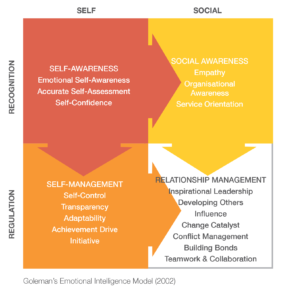
Anyone who has ever googled Emotional Intelligence will start with Daniel Goleman, and while I completely agree with his model for ease of training and scalability, I wish it hadn’t taken me half my work life full of anger, annoyance, disappointment and pain to prove him right.
What’s all the fuss about, you ask? Why have companies been investing in Emotional intelligence? Because it is the ability to :
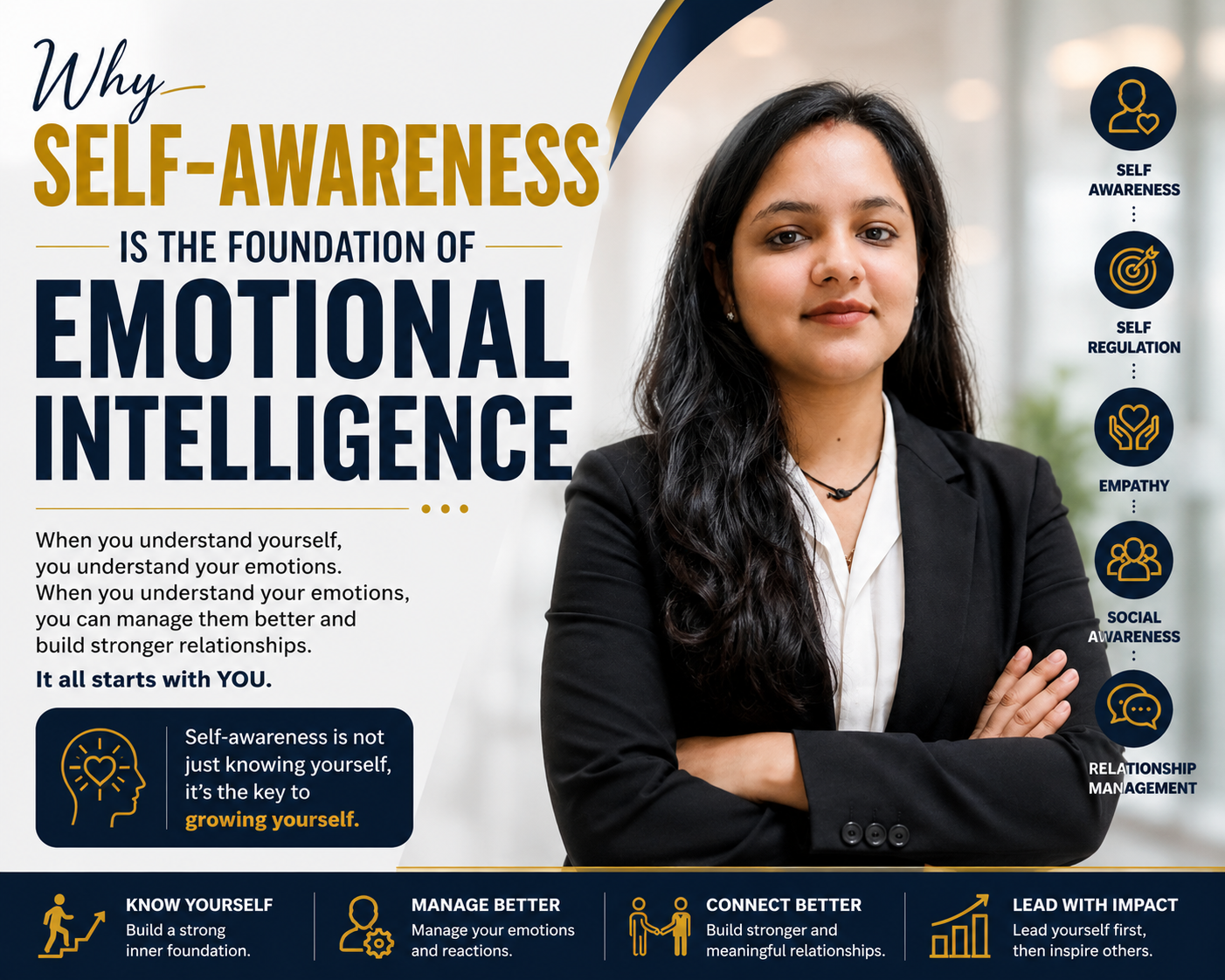
- Recognize your own emotions ( Self-awareness )
- Understand how emotions affect behavior and decisions ( Motivation )
- Manage emotional responses effectively ( Self-regulation )
- Understand other people’s emotions ( Empathy )
- Build productive relationships ( Social skills )
And how does that help them? You? Us? Because it leads to :
- Better leadership performance
- Lower employee conflict
- Higher engagement
- Stronger customer relationships
- Improved retention
- Better cross-functional collaboration
- Reduced burnout
- More effective change management
The next big question is – How? How do I do all the above as an individual? How do I teach it? Or if’s I’m a Company, what, exactly am I expecting out of my employees?
Self-Awareness –
catching yourself in that moment when your emotions are triggered. Noticing your muscles tighten, your anger swell or your being shrinking.
Self-Regulation –
Stopping yourself from your usual impulsive reaction. Breathing. Pausing. Managing that stress response differently by de-escalating yourself or the situation. Noticing and choosing to do it differently this time.
Empathy –
Understanding that your experience is not theirs and that’s ok. Both ways. That theirs isn’t yours either , but both are valid and have a right to exist. Understanding that while you might have done it differently, both of you are doing the best you can with the hand you’ve been dealt.
Social Skills & Relationship Management –
Giving feedback in a manner that actually helps and is received as such. It’s also about receiving criticism without attacking the person or feeling completely shattered. It’s about learning to sift out what benefits you and shrug off the rest. It’s also about building trust that can be trusted.
Leadership Emotional Intelligence –
It’s the ability to leading under uncertainty without transferring that stress down. It’s about motivating each individual with their specific motivators, while managing team morale with honesty and accessibility when making difficult decisions
So how does one teach that and what does a good program look like?
Effective programs are:
- Practical, not overly theoretical. Discuss real scenarios with real people.
- Behaviour-focused. What behaviours, specifically need improvement?
- Role-specific- It needs to be customized for each role, industry and sometimes, even specific situations
- Reinforced over time – What evidence supports effectiveness
- Supported by managers – What reinforcement exists after workshops
- Measurable – Does this show in retention, promotions, Skip levels?

But:
- It won’t fix toxic leadership alone
- It can’t compensate for poor systems
- It fails without cultural reinforcement
- It requires consistent practice
I’ll end with a personal, lived story. I once worked as a junior manager in a company with an extremely toxic culture. I was intimidated, belittled, vilified and isolated. I put my head down and worked through it. To this day, I don’t know why I did that. I don’t know why I didn’t just leave, but one day, I met an ex colleague socially and mouthed off about my boss. The ex-colleague tattled straight to that boss and I was called into his office the next day and asked point blank, if I’d said what I’d said. Obviously, I thought I was losing my job and so, I finally took up for myself. I told me boss about all the treatment I’d faced and how he, not once, asked about me, as an employee. From the next day onward, he came to my cubicle every day to chat, to check and to let me know that he cared. Today, neither of us works at the same place but we are incredible friends.
That is Emotional Intelligence.