

In an increasingly competitive and technology-driven world, technical expertise alone is no
longer sufficient to ensure professional success. The ability to communicate effectively,
collaborate with others, manage emotions, resolve conflicts, and adapt to change has become
equally important. These capabilities, collectively known as soft skills, enable individuals to
translate their knowledge into meaningful workplace performance. Soft skills training,
therefore, is not merely an additional learning intervention; it is an investment in people and
organisational effectiveness.
“Great things in business are never done by one person. They’re done by a team of
people.”
— Steve Jobs, co-founder of Apple Inc.
Source: Steve Jobs, biography by Walter Isaacson, published by Simon & Schuster, 2011.
The quotation is widely attributed to Jobs and reflects the importance of teamwork in
organisational success.
*Understanding Soft Skills Training
Soft skills refer to the interpersonal, behavioural, and emotional competencies that influence
how individuals work, interact, and respond to different situations.
Key areas include communication, leadership, emotional intelligence, teamwork, problem-
solving, time management, conflict management, presentation skills, adaptability, and
professional etiquette.
Why Is Soft Skills Training Important?
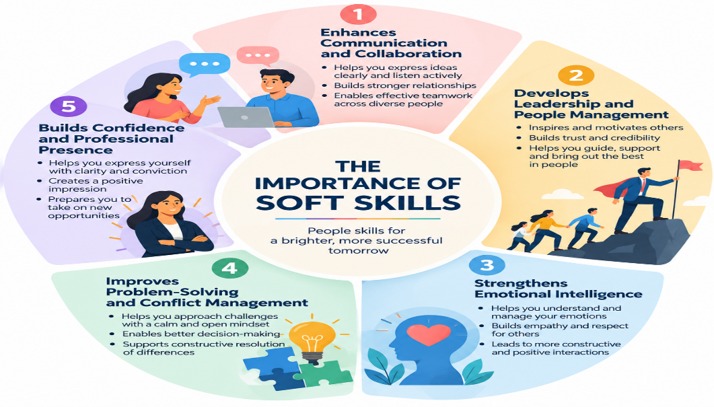
1. Enhances Communication and Collaboration
Effective communication is the foundation of successful workplace relationships. Employees
must be able to express ideas clearly, listen actively, ask relevant questions, and provide
constructive feedback. Soft skills training helps individuals recognise communication
barriers, appreciate different perspectives, and collaborate more effectively.
2. Develops Leadership and People Management
Leadership is not restricted to individuals occupying senior positions. Employees at every
level can demonstrate leadership by taking initiative, accepting responsibility, influencing
others positively, and supporting team objectives.
3. Strengthens Emotional Intelligence
Emotional intelligence enables individuals to understand their emotions, regulate their
reactions, and recognise the feelings and needs of others. In a demanding work environment,
this capability helps employees handle pressure, respond constructively to criticism, and
navigate difficult conversations.
4. Improves Problem-Solving and Conflict Management
Workplace challenges often arise from competing priorities, differences in opinion, unclear
expectations, or limited resources. Employees who approach such situations with a solution-
oriented mind-set are better equipped to identify the root cause of a problem and explore
practical alternatives.
5. Builds Confidence and Professional Presence
The ability to present ideas confidently, participate in meetings, interact with stakeholders,
and communicate with clarity can significantly influence professional effectiveness.
What Makes Soft Skills Training Effective?

The success of a training programme depends not simply on the quality of its content but
also on how effectively participants translate learning into behaviour.
Activities such as case studies, role-plays, group challenges, and workplace simulations
allow participants to practise skills in a supportive environment. Constructive feedback helps
them recognise their strengths, identify development areas, and make meaningful
improvements.
Organisations can also evaluate effectiveness through participant feedback, observed
behavioural improvements, and relevant workplace indicators, such as collaboration,
communication quality, and team effectiveness.
The Role of Organisations and Trainers
Organisations must recognise that soft skills are not developed through one-time
interventions alone. They require consistent reinforcement and a workplace culture that
values respect, accountability, inclusion, and continuous learning.
Trainers play a crucial role in creating engaging learning experiences that connect concepts
with real workplace situations. They must go beyond delivering information to facilitate
reflection, encourage participation, challenge limiting behaviours, and help individuals
discover practical ways to improve.
Conclusion
In a world where technology continues to transform the way we work, human skills remain
central to professional success. Organisations need individuals who can think critically,
communicate thoughtfully, collaborate effectively, and respond constructively to change.
Ultimately, investing in soft skills is investing in the human capabilities that transform
individual competence into collective success. When people learn to work better with
themselves and with others, they create not only more productive workplaces but also more
respectful, resilient, and high-performing organisations.