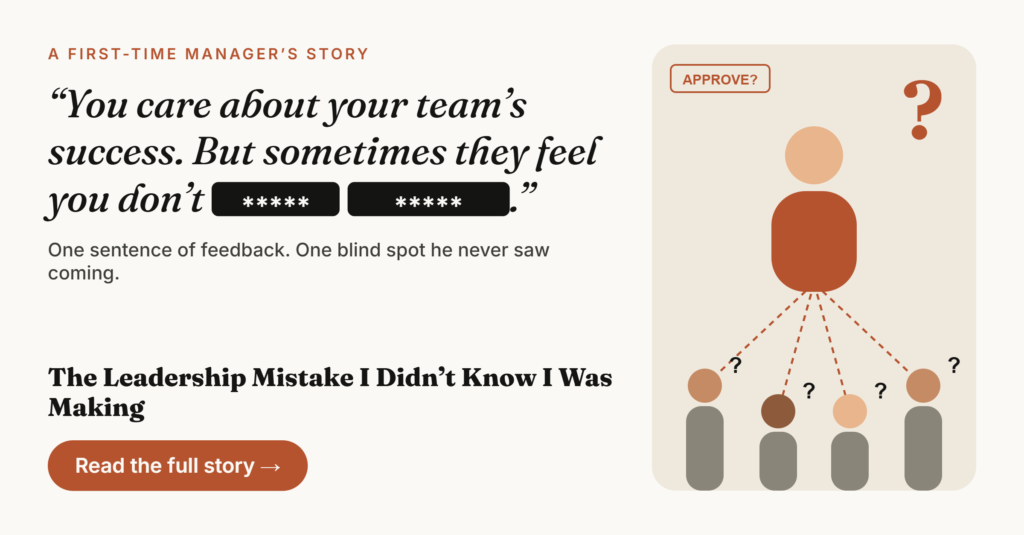
“The feedback that changed my leadership journey came in a single sentence:
You care about your team’s success. But sometimes they feel like you don’t trust them.
As a first-time manager, those words were difficult to hear. Yet they exposed a leadership blind spot I didn’t know I had”.
This is the story of Tejas, a hardworking software engineer who discovered that the habits that drive individual success can sometimes limit team success.
Tejas’s life was built on discipline. As a student, he believed success came from effort, not just talent. One of his biggest influences was his mathematics teacher, Miss Rita. Miss Rita was strict and uncompromising. She groomed them to be the best. Deadlines mattered. Excuses didn’t. Mistakes were corrected immediately. While some students feared her, Tejas admired her. He saw a teacher who genuinely cared about helping students achieve their potential. Those years taught him accountability, preparation, and the value of high standards.
The lessons stayed with him long after graduation.
As a software engineer, Tejas quickly earned a reputation for reliability. He volunteered for difficult assignments, solved challenging problems, and consistently delivered results.
Early in his career, he worked with a manager named Achyut. He was a highly involved leader who believed inworking closely with the team and creating clarity. Teams rarely struggled with priorities because expectations, timelines, and outcomes were clearly communicated. During critical projects, Achyut stayed closely connected with the team, offering guidance, removing roadblocks, and helping the team navigate complexity.
For a young engineer, this leadership style was inspiring. Under Achyut’s leadership, Tejas learned how successful projects were planned,
executed, and delivered. Over time, he developed a simple belief:
Great leaders stay closely involved.
Years later, after consistently exceeding expectations, Tejas earned a promotion; he became a project manager. Like most first-time PMs, he genuinely wanted to lead his team towards success. Naturally, he leaned on the experiences that had shaped him. He adopted Miss Rita’s discipline. He adopted Achyut’s involvement. And without realizing it, he crossed a line. Tejas began asking for frequent updates. He reviewed presentations before they were shared. He examined technical documents in detail. He wanted visibility into every significant decision.
His intentions were good. He wasn’t trying to control people. He was trying to help them avoid mistakes and deliver better outcomes.
But leadership is not measured by intent; it is measured by impact.
Gradually, subtle changes appeared within the team. Employees became hesitant to make decisions independently. Team members stopped proposing bold ideas because they expected every suggestion to be reviewed or redirected. Meetings became quieter. Creativity declined. Risk-taking decreased.
What Tejas viewed as guidance was increasingly being experienced as control.
Soon, the consequences became visible. Decision-making slowed because too many things required managerial approval. Employees lost confidence in their judgment. High performers felt constrained instead of empowered. Most concerning of all, ownership began to disappear. Instead of asking, “What’s the best solution?”, people started asking, “What does Tejas want us to do?”
At the same time, Tejas’s own workload became overwhelming. His calendar filled with reviews, approvals, follow-ups, and status meetings. Instead of focusing on strategy, coaching, and team development, he spent his days managing details. Eventually, the team’s performance suffered. Deadlines slipped, engagement declined, and the star individual contributor was struggling in his first assignment as a leader .
Recognizing the challenge, Tejas’s manager enrolled him in a leadership development workshop. In one of the feedback session during the workshop, one comment stood out:
“You care about your team’s success. But sometimes they feel like you don’t trust them.”
The statement forced Tejas to introspect on his style of working. As he got clarity, he realised that Miss Rita’s;s strictness worked because she was teaching students who needed structure. Achyut’s directive leadership worked because it was balanced with trust. He knew when to step in and when to step back. He now understood that he had stayed involved even when his team was fully capable of handling the work themselves. He had confused guidance with control.
That awareness turned out to be a turning point for his career. He changed his working style – he started practicing delegation that he learnt in workshop. He identified subject matter experts within the team and started giving them ownership for their respective areas of expertise. He encouraged experimentation, and focused on outcomes rather than methods. Most importantly, he started trusting people before they proved they deserved trust.
Slowly, team noticed this change in his working style. They started enjoying ownership. Ownership increased. Confidence returned. Ideas
flowed more freely. Team engagement improved, and so did the performance.
Leadership Takeaway
Discipline builds high performers. Trust builds future leaders.
The best leaders are not remembered for the decisions they made themselves. They are remembered for the people they developed.