
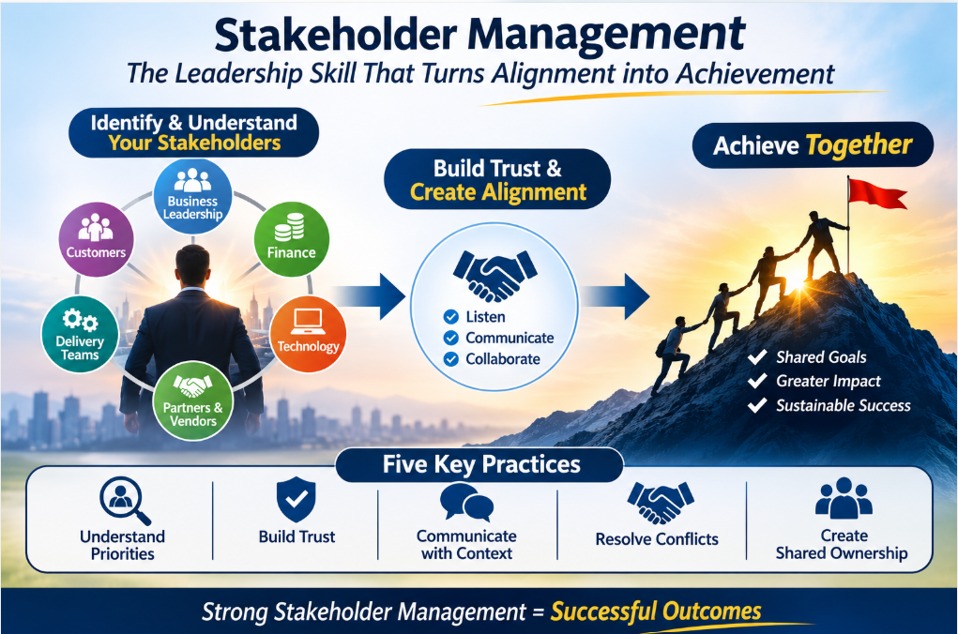
Why great leaders don’t just manage deliverables; they manage relationships,
expectations and trust.
In leadership, we often talk about strategy, execution, decision-making and team
management. But there is one capability that often determines whether a strategy
succeeds or struggles: Stakeholder Management.
Over two decades of working across large IT transformation programmes, global
delivery teams and diverse business environments, I have realised that even the
best strategy or the most capable team cannot guarantee success if the
stakeholders are not aligned.
Why? Because every stakeholder views the same initiative through a different lens.
A CEO may focus on business growth and competitive advantage. A CFO may be
concerned about budgets, costs and returns. A technology leader may prioritise
scalability, security and technical excellence. Business teams may expect faster
outcomes, while delivery teams are focused on timelines, resources and execution.
All these expectations are valid, but they are not always aligned.
This is where leadership truly comes into play.
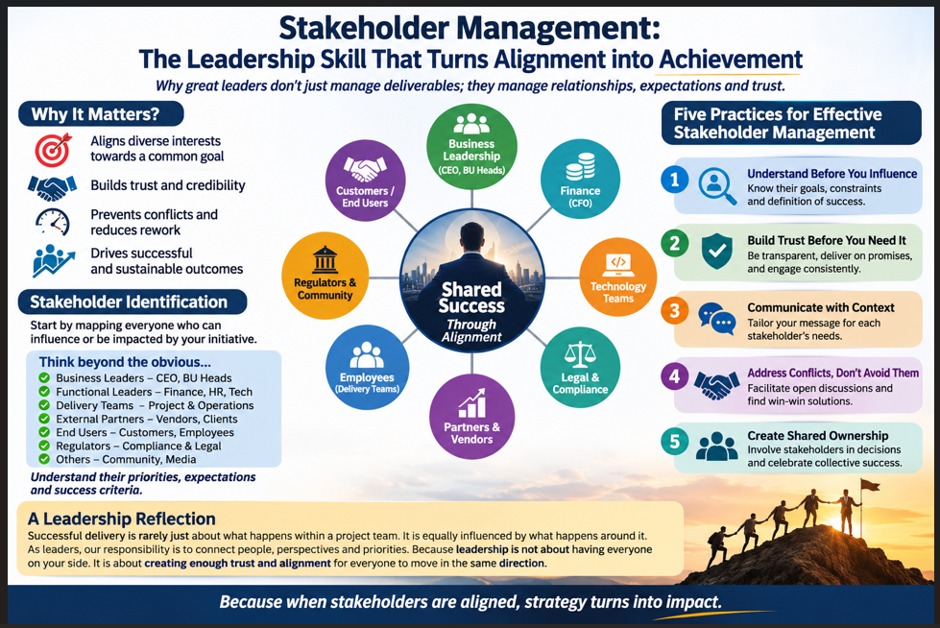
1) Stakeholder Management Begins with Stakeholder Identification
Before managing stakeholders, a leader must first identify them.
One common mistake leaders make is engaging only with the obvious stakeholders
– the project sponsor, reporting manager or client
Effective stakeholder identification requires leaders to look beyond the organisational
hierarchy and understand who can influence, enable, challenge or be impacted by
an initiative.
For example, in a large technology transformation, the stakeholder landscape could
include:
Business Leadership: CEO, business heads and programme sponsors who
define strategic priorities.
Functional Leaders: Finance, HR, operations and technology leaders who
influence business processes.
Delivery Teams: Project managers, architects, developers and operational
teams
External Stakeholders: Customers, vendors, consultants and
implementation partners.
Governance Stakeholders: Risk, legal, compliance and regulatory teams.
End Users: Customers whose adoption ultimately determines the success of
the transformation.
A useful leadership practice is to map stakeholders based on two dimensions: their
level of influence and their level of interest or impact.
High-influence stakeholders require close engagement and alignment. Those directly
impacted need regular communication and involvement.
The objective is identify the right people, understand what matters to them and
engage them at the right time.
Remember, the stakeholder you overlook today could become the biggest
roadblock tomorrow.
2) Stakeholder Management Is More Than Communication
Many people mistake stakeholder management for scheduling meetings, sharing
status reports or providing periodic updates.
It goes much deeper.
It is about understanding what matters to each stakeholder, anticipating concerns,
managing expectations and creating a shared understanding of what success looks
like.
Consider a large technology transformation programme. The business wants faster
delivery, finance expects cost optimisation, and technology teams need sufficient
time to ensure quality and stability.
A leader who simply communicates project progress may keep everyone informed,
but may not necessarily keep everyone aligned.
An effective leader brings these perspectives together, facilitates difficult
conversations, makes trade-offs transparent and ensures that decisions are taken
with a common business objective in mind.
The goal is not to make everyone agree on everything. It is to help everyone move
forward with clarity and commitment.
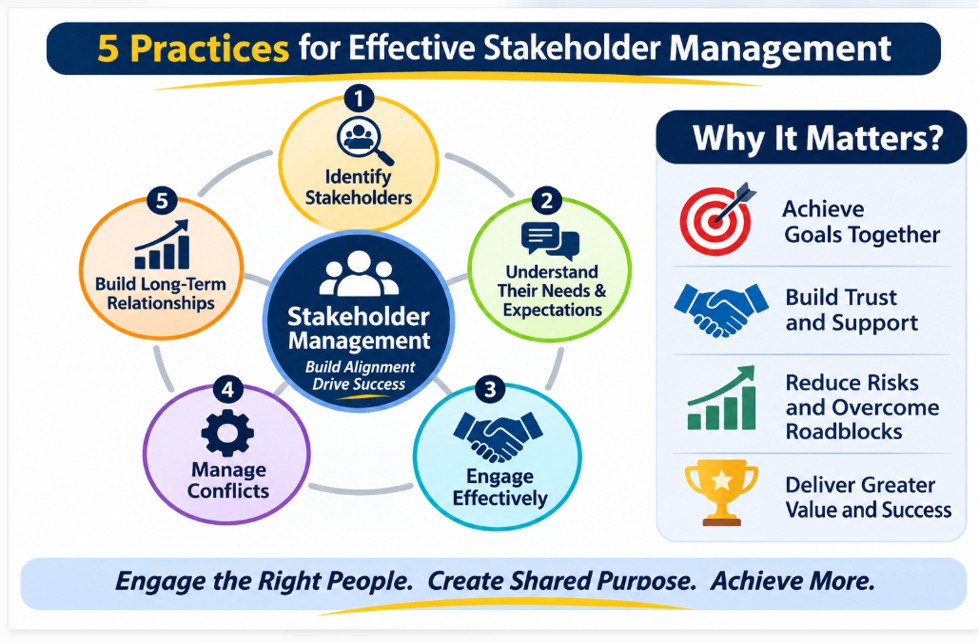
3) Five Practices That Make Stakeholder Management Effective
1. Understand Before You Influence
Invest time in understanding each stakeholder’s priorities, expectations, pressures
and definition of success. Never assume that everyone measures success the same
way.
2. Build Trust Before You Need It
Trust is not built during a crisis. It is built through consistent engagement,
transparency, accountability and delivering on commitments. When challenges arise,
established trust makes difficult conversations easier.
3. Communicate with Context, Not Just Updates
Different stakeholders need different conversations. A senior business leader may
need to understand business impact, while a delivery team needs clarity on priorities
and execution. Tailor the message without changing the facts.
4. Address Conflicts, Don’t Avoid Them
Conflicting priorities are inevitable. Strong leaders bring disagreements to the table,
encourage constructive discussions and facilitate decisions. Avoiding uncomfortable
conversations only makes problems bigger.
5. Create Shared Ownership
Stakeholders should not feel that they are merely receiving updates. They should
feel involved in its success. Involve them in key decisions, recognise contributions
and make accountability collective.
4) A Leadership Reflection
One lesson that has stayed with me throughout my professional journey is that
successful delivery is influenced by what happens around it.
You may have the right people, the right technology and the right execution plan. But
without stakeholder alignment, even a well-planned initiative can lose direction.
Leaders responsibility is not simply to manage upwards, downwards or across the
organisation. It is to connect people, perspectives and priorities.
Leadership is not about having everyone on your side. It is about creating
enough trust and alignment for everyone to move in the same direction.
And that is what turns stakeholder management from a management activity into a
true leadership capability.
Article by:
Sundar Viswanathan
Founder & Chief Transformation Officer | Grow2Transform.com
ICCC(UK) Licensed Career : Counselling | Coaching | Certified Corporate &
Leadership Trainer