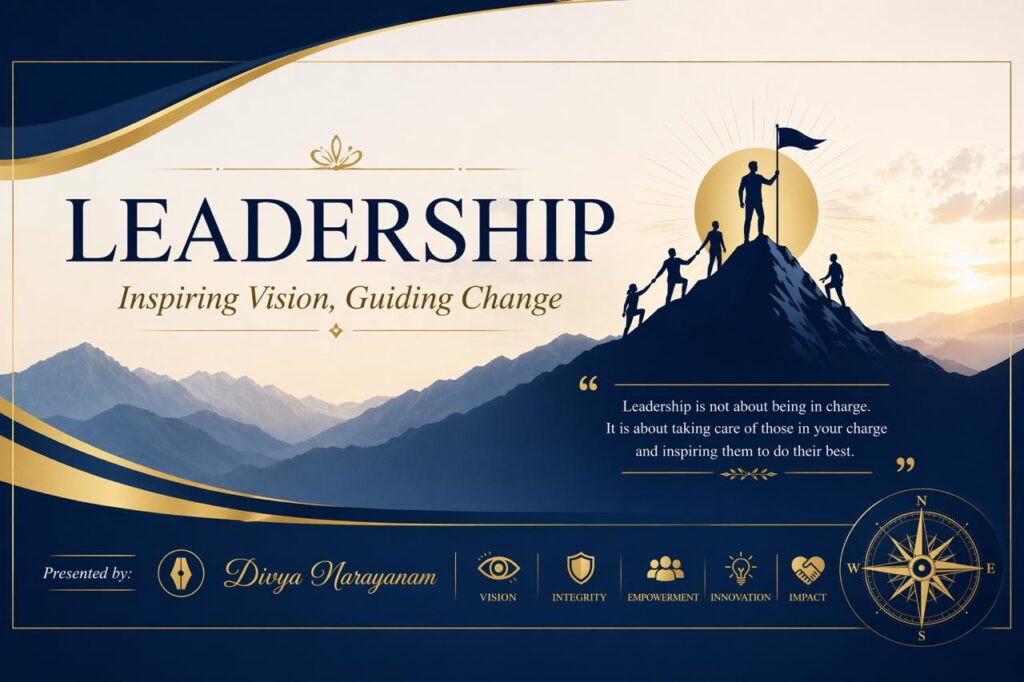

Leadership is the ability to influence, inspire, and guide individuals or teams toward achieving a shared vision. In an ever-evolving world, effective leadership plays a critical role in shaping organizations, communities, and nations. It is not defined by authority or position but by the capacity to inspire trust, foster collaboration, and drive meaningful change. True leaders empower others, act with integrity, and create a lasting impact through their vision and actions.
One of the most remarkable examples of leadership in modern India is Dr. A.P.J. Abdul Kalam, fondly known as the “Missile Man of India” and the People’s President. Rising from humble beginnings, Dr. Kalam demonstrated that leadership is rooted in perseverance, knowledge, and humility. As a scientist and the 11th President of India, he played a pivotal role in advancing India’s missile and space programs, significantly strengthening the nation’s defense capabilities. Beyond his scientific achievements, he inspired millions of young minds through his speeches and writings. His famous words, “Dream, dream, dream. Dreams transform into thoughts and thoughts result in action,” reflect his visionary leadership. His emphasis on education, innovation, and national development continues to motivate aspiring leaders worldwide.
Indian epics also offer timeless lessons in leadership. Lord Rama, the central figure of the Ramayana, exemplifies ethical and values-based leadership. Known as “Maryada Purushottam,” Rama upheld righteousness, integrity, and duty even in the face of personal hardships. His decision to accept exile to honor his father’s promise demonstrates his commitment to ethical governance and responsibility. As a ruler, he established “Rama Rajya,” an ideal state characterized by justice, prosperity, and equality. His leadership highlights the importance of moral courage, accountability, and leading by example.
Similarly, Lord Krishna from the Mahabharata represents strategic and transformational leadership. Serving as Arjuna’s charioteer and guide during the Kurukshetra war, Krishna imparted the profound wisdom of the Bhagavad Gita. He encouraged Arjuna to fulfill his duty with clarity, courage, and detachment from outcomes. Krishna’s leadership emphasizes emotional intelligence, adaptability, and the power of strategic thinking. His ability to navigate complex situations and inspire action underscores the significance of wisdom and foresight in effective leadership.
The impact of leadership is evident in organizations and societies worldwide. According to a Gallup study, organizations with highly engaged teams experience a 21% increase in profitability and a 17% rise in productivity. Research by Deloitte’s Global Human Capital Trends report indicates that over 80% of organizations consider leadership a top priority for business success. Furthermore, Harvard Business Review highlights that strong leadership significantly enhances employee motivation, innovation, and retention. These statistics underscore the transformative power of effective leadership in driving growth and organizational excellence.

Effective leaders share certain core qualities, including vision, integrity, empathy, resilience, and the ability to communicate effectively. They inspire trust, encourage innovation, and cultivate a culture of collaboration and continuous learning. In today’s dynamic and interconnected world, leadership also demands adaptability, inclusivity, and a commitment to ethical decision-making.
In conclusion, leadership is a powerful force that shapes the destiny of individuals, organizations, and nations. The lives of Dr. A.P.J. Abdul Kalam, Lord Rama, and Lord Krishna illustrate that true leadership transcends time and context, blending vision with values and strategy with compassion. Whether in boardrooms, classrooms, or communities, effective leaders inspire others to achieve their highest potential and contribute to a better world. As the challenges of the modern era continue to evolve, the need for principled and visionary leadership remains more important than ever.
Inspirational Quotes on Leadership
“Dream, dream, dream. Dreams transform into thoughts and thoughts result in action.” – Dr. A.P.J. Abdul Kalam
“A leader is one who knows the way, goes the way, and shows the way.” – John C. Maxwell
“Whenever there is a decline in righteousness… I manifest myself.” – Lord Krishna, Bhagavad Gita.
“The greatest leader is not necessarily the one who does the greatest things. He is the one that gets people to do the greatest things.” – Ronald Reagan.
References
Gallup. (2020). State of the Global Workplace Report.
Deloitte. (2023). Global Human Capital Trends Report.
Harvard Business Review. Articles on Leadership and Organizational Performance.
Kalam, A.P.J. Abdul. Wings of Fire. Universities Press.
Valmiki. Ramayana.
Vyasa. Mahabharata and the Bhagavad Gita.