
Artificial Intelligence has rapidly become part of everyday work. It can write code, analyze data, draft reports, and answer complex questions within seconds. Tasks that once required entire teams and several days are now completed in minutes. This progress naturally raises an important question for every professional: if machines can now handle so much of the technical work, what should humans focus on developing instead?
The answer lies not in competing with AI, but in strengthening the skills it cannot replicate.
Understanding the Shift:
AI has undoubtedly transformed how work gets done. It can process information faster than any individual, identify patterns across large datasets, and generate first drafts of nearly anything, from emails to research summaries. Organizations that once depended on large teams for research, writing, and analysis are now accomplishing the same output with far fewer resources.
This shift is not something to resist; it is something to understand and build on. Every major technological advancement follows a similar pattern: it automates a category of work and, in doing so, increases the value of everything that remains uniquely human. The calculator did not eliminate the need for mathematicians; it simply meant they were valued for reasoning rather than arithmetic. AI is following the same trajectory. As routine and technical tasks become automated, human judgment, connection, and leadership grow more important, not less.
What Technology Still Cannot Do:
1. Reading the Room
AI can analyze sentiment within a piece of text, but it cannot sense tension in a meeting, notice when a colleague has grown unusually quiet, or recognize the right moment to pause a discussion before it escalates. This awareness comes from paying close attention to people, not processing data, and it often determines whether a conversation is resolved smoothly.
2. Building Trust
People do not follow tools; they follow people. Clients remain loyal because they trust the individuals they work with, not because a report was generated efficiently. Employees stay engaged in workplaces where they feel valued and understood. Trust is built gradually, through consistency, honesty, and genuine relationships, and it remains entirely a human responsibility.
3. Judgment in Uncertainty
AI provides confident answers even in situations that are inherently unclear. It cannot weigh unspoken workplace dynamics, long-term relationships, or the human impact of a decision the way an experienced professional can. In ambiguous, high-stakes situations, such as a difficult client conversation or a sensitive personnel matter, sound judgment shaped by experience remains essential.
4. Leading and Motivating People
Effective leadership involves inspiring a team through a challenging period, delivering feedback that builds confidence rather than discouragement, and creating a genuine sense of purpose at work. Leadership depends on understanding individual people, not simply managing outputs, and it cannot be generated through a prompt.
Why This Matters for Organizations Today
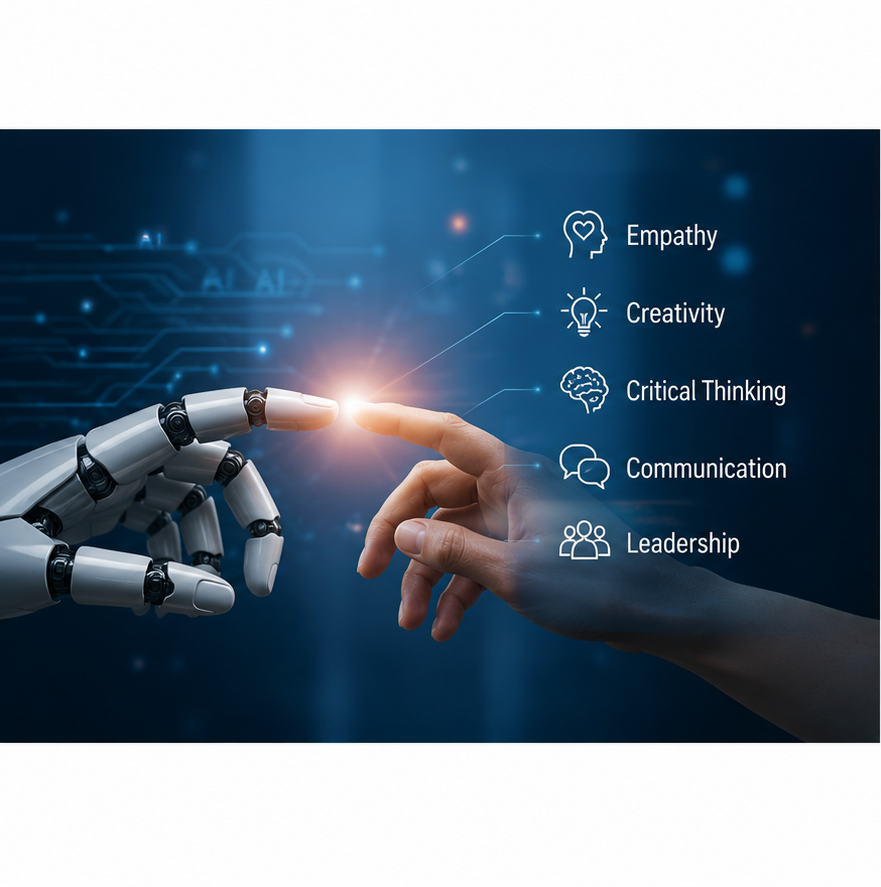
As technical work becomes increasingly automated, the skills that distinguish strong employees and leaders are shifting. Organizations are recognizing this shift as well, which is why investment in emotional intelligence, communication, leadership, and conflict management training continues to grow. Corporate training programs are no longer considered optional; they are becoming essential to building teams capable of doing what technology cannot: connect, lead, and adapt.
Conclusion
AI has changed what gets a person hired. It has not changed what gets a person promoted, trusted, or remembered. As machines take on more of the technical workload, the professionals who stand out will be those who lead with empathy, communicate with clarity, and build trust that no algorithm can replicate. The future of work is not about competing with AI; it is about moving beyond it.