

Traditional conflict management often focus on resolving disagreements after they arise, but the ICSRF Approach offers a different perspective: it transforms conflict into an opportunity to improve communication, strengthen relationship, accelerate decision making, and drive organisational performance.
Rather than treating conflict as a disruption, ICSRF encourages organisations to treat it as valuable information that, when managed constructively, can lead to better outcomes.
Workplace conflicts are inevitable but can significantly impact team productivity if not managed effectively. Unresolved issues may lead to decreased work output, negative attitudes, and higher employee attrition.
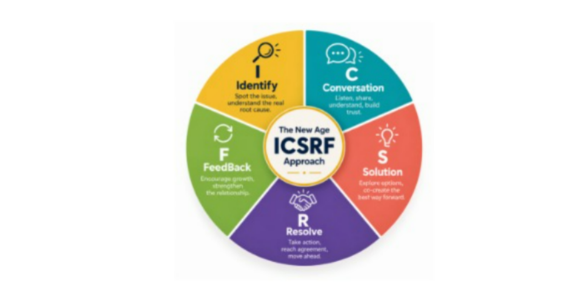
The framework is built on five interconnected pillars that take people from identifying the real issue to creating a lasting resolution and learning from the experience.
Let us not understand the 5 Pillars of ICSRF Approach for Handling Conflicts :
- I— Identify
- C— Conversation
- S— Solution
- R— Resolve
- F— FeedBack
-
Identify
the real source of conflict instead of reacting to the visible Is it a communication gap, unclear accountability, competing priorities, resource constraints, or a difference in expectations?
The unique practice: The Conflict Scanner
Before taking sides, each person answers three questions: What happened? What is the impact? What needs to change?
Outcome: Clarity without blame.
-
Create a structured Conversation
in which all parties can speak openly, listen actively, and understand perspectives without interruption or personal
The unique practice: People’s Perspective
Each person explains their perspective. The other person must first summarise what they heard before responding.
The objective is not to agree immediately, but to understand accurately.
Outcome: Effective Listening and mutual understanding.
-
Solution:
Shiftthe focus from “Who is right?” to “What will work best for the organisation?”
Generate options that address shared objectives rather than individual perspectives.
The unique practice: The Common-Ground
Ask both parties to develop at least three possible solutions, evaluate them against agreed business outcomes, and select the most workable option together.
Outcome: Team Work turned Smart Solutions.
-
Resolve :
Convertthe agreed solution into clear
Define who will do what, by when, and how the success will be measured.
The unique practice: The Resolution Pact
End every conflict-resolution meeting with an action owner, deadline, success measure, and follow up date.
Record the agreement so that it does not remain a verbal promise.
Outcome: Accountability, execution, and closure.
-
Feedback:
Assesswhether the resolution worked, whether trust was restored, & whether the same issue is likely to
The unique practice: The Conflict-to-Learning Loop
After an agreed period, ask: What improved? What remains unresolved? What should we do differently next time?
Use the learning to improve team processes and working relationships.
Outcome: Sustainable resolution and organisational learning.
What makes ICSRF different?
The real differentiator is not just the five steps. It is the way an organisation uses them.
| Traditional response | ICSRF response |
| Find out who is at fault | Identify the underlying issue |
| Defend positions | Understand perspectives |
| Push for a quick compromise | Co-create a business-focused solution |
| End the meeting with verbal agreement | Establish measurable commitments |
| Move on and forget | Capture feedback and prevent recurrence |
The fundamental shift: ICSRF makes conflict resolution a repeatable organisational capability, rather than a skill used only when a manager intervenes.
The Golden Rule
No conflict discussion should end without clarity on three things:
- Agreement : What have we decided?
- Accountability : Who will do what, and by when?
- Assessment : How will we know the conflict has genuinely been resolved?
The 15-Minute Huddle : A Practical Tool
Suggested timings for a routine workplace disagreement; complex or sensitive cases may need more time.
I : 3 minutes — Identify
Each team states the issue and its business impact, without blame.
C : 4 minutes — Conversation
Each person speaks and is heard without interruption.
S : 3 minutes — Solution
Generate options and agree on the best next step.
R : 3 minutes — Resolve
Assign responsibility, deadlines, and success measures.
F : 2 minutes — FeedBack
Confirm how and when the outcome will be reviewed.
The transformation / Conclusion
The organisation does not merely settle an argument. It fixes the process that caused the argument, strengthens collaboration, and creates a more reliable customer experience.