
Diversity can bring people into the room. But psychological safety determines whether they feel safe enough to speak once they are there.
Organizations today invest significantly in diversity hiring, inclusion programmes, employee engagement, and leadership development. Yet one critical question often remains:
Do people genuinely feel safe enough to speak up?
This is where psychological safety becomes central to inclusive leadership.
What Is Psychological Safety?
Harvard Business School professor Amy Edmondson describes psychological safety as a shared belief that a team is safe for interpersonal risk-taking.
In practice, it means people can:
- Ask questions without fear of looking incompetent
- Admit mistakes without fear of humiliation
- Challenge ideas respectfully
- Express concerns and alternative perspectives
- Say, “I don’t know”
- Ask for help
- Raise issues when something does not feel right
Psychological safety does not mean removing accountability or lowering performance standards. It means creating an environment where people can be honest, curious, and willing to learn without fear of embarrassment or punishment for speaking up.
Diversity Brings People In. Inclusion Gives Them a Voice.
A team can be diverse on paper—but is everyone truly heard?
Ask:
- Who speaks up?
- Whose ideas are valued?
- Who gets interrupted?
- Who stays silent?
Diversity brings different perspectives. Psychological safety creates the space for those perspectives to be expressed, heard, and valued.
Because representation means being present.
Inclusion means having a voice.
Why Psychological Safety Matters
Psychological safety has implications far beyond employee experience.
When people feel safe to speak, organizations are better positioned to:
- Identify risks earlier
- Challenge assumptions
- Learn from failures
- Generate new ideas
- Solve complex problems
- Collaborate more effectively
- Adapt and innovate
When people do not feel safe, critical information may remain unspoken.
And silence can carry a significant organizational cost.
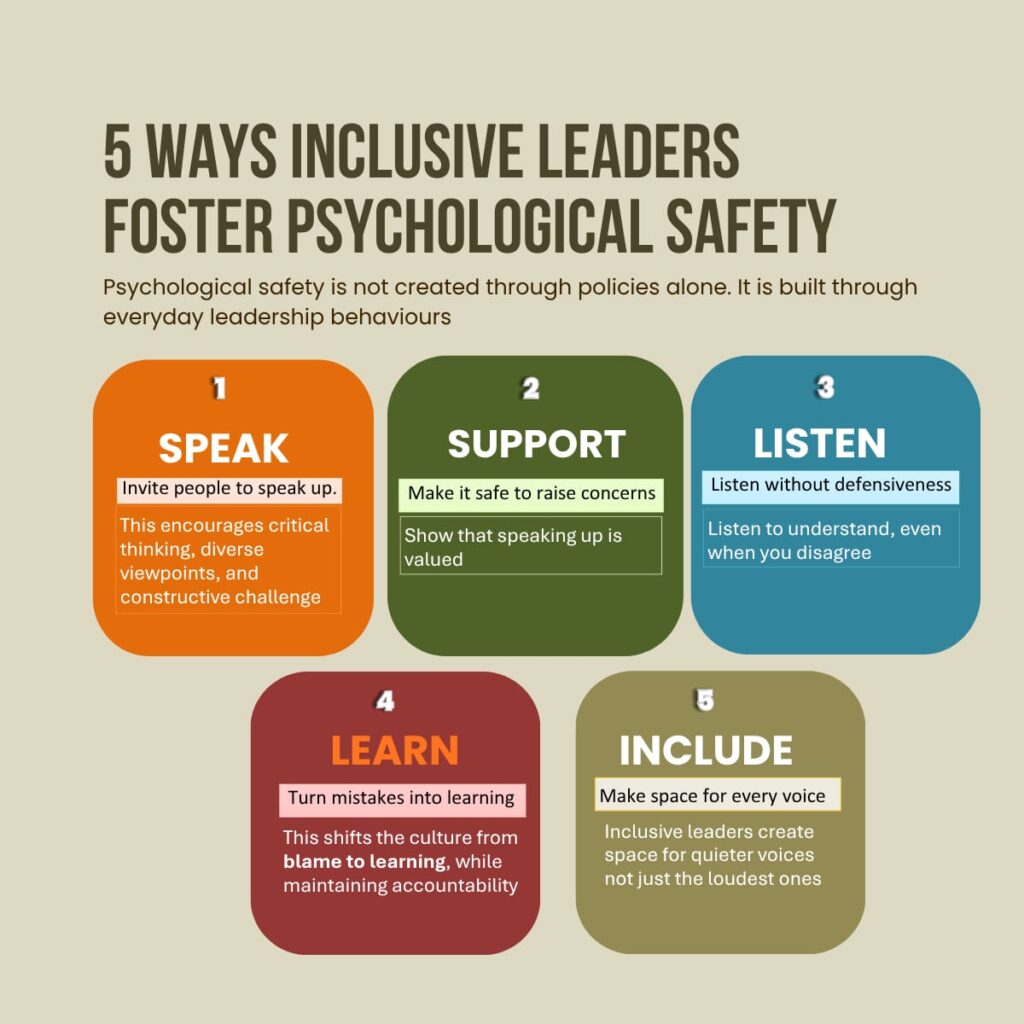
Five Ways Inclusive Leaders Foster Psychological Safety
Psychological safety is not created through policies alone. It is built through everyday leadership behaviors.
1. SPEAK — Invite People to Speak Up
Instead of asking:
“Does everyone agree?”
ask:
“What perspectives are we missing?”
This simple shift opens the door to disagreement, questions and critical thinking.
Inclusive leaders do not measure success by how quickly everyone agrees. They create space for people to challenge assumptions and offer different viewpoints.
2. SUPPORT — Make It Safe to Raise Concerns
When someone says, “I think there may be an issue with this approach,” the leader’s response matters.
A dismissive reaction can teach employees to stay silent.
A curious response such as:
“Tell me more. What are you seeing that we may be missing?”
sends a very different message:
Speaking up is valued here.
Teams learn what is safe by observing how leaders respond, particularly when the message is uncomfortable.
3. LISTEN — Listen Without Defensiveness
An open-door policy means little if employees feel unheard once they walk through it.
Psychological safety is shaped by the quality of the listening experience.
Inclusive leaders listen to understand before responding. They may not agree with every perspective, but they demonstrate that every contribution deserves consideration and respect.
Being heard does not always mean being agreed with.
4. LEARN — Turn Mistakes into Learning
Accountability remains essential. But the way leaders respond to mistakes can determine whether employees hide problems or surface them early.
Instead of asking only:
“Who made the mistake?”
Ask:
- What happened?
- What can we learn?
- What needs to change?
- How can we prevent this from happening again?
This shifts the culture from blame to learning.
When employees know that mistakes can be discussed constructively, problems are more likely to be identified early and addressed effectively.
5. INCLUDE — Make Space for Every Voice
Silence does not always mean agreement.
It may indicate fear, hierarchy, previous negative experiences, uncertainty, or simply the belief that speaking will not make a difference.
Inclusive leaders therefore ask:
“Whose voice is missing from this conversation?”
They intentionally create space for quieter voices and ensure that participation is not limited to the most senior, confident, or vocal individuals.
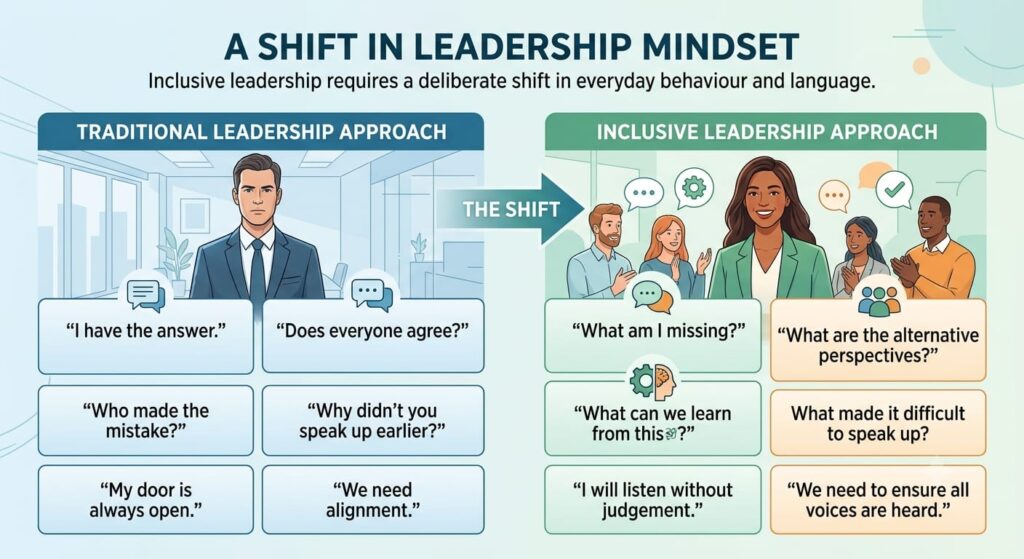
From Traditional Leadership to Inclusive Leadership
The shift can begin with small changes in everyday language:
“I have the answer.” → “What am I missing?”
“Does everyone agree?” → “What are the alternative perspectives?”
“Who made the mistake?” → “What can we learn from this?”
“Why didn’t you speak up earlier?” → “What made it difficult to speak up?”
“My door is always open.” → “I will listen without judgement.”
These may seem like small changes, but repeated leadership behaviors shape culture.
Conclusion
Inclusive leadership is not about having all the answers.
It is about creating an environment where people feel:
Safe to SPEAK.
Supported when they do.
Heard through genuine LISTENING.
Encouraged to LEARN.
And intentionally INCLUDED.
SPEAK • SUPPORT • LISTEN • LEARN • INCLUDE
Because true inclusion is not simply about who gets a seat at the table.
It is about whether people feel safe enough to use their voice once they are there.
And that is where meaningful inclusive leadership begins.