
We live in a world where communication has never been easier.
A message can travel across the world in seconds. We have emails, instant messaging, video calls, social media and now Artificial Intelligence to help us draft, respond and even communicate more efficiently.
But here is a question worth asking:
With all the technology around us, how much do we actually talk to the people around us?

How often do we sit down and have a meaningful conversation with our family? How often do we speak to our friends instead of simply reacting to their social media posts? At the workplace, how often do we actually talk to our colleagues rather than communicating through emails and messages?
Technology has made communication faster. But has it made communication better?
Communication is more than exchanging words
Interpersonal communication is the exchange of thoughts, ideas, feelings and information between two or more people. It is not simply about speaking. It is about listening, understanding, responding and connecting.
A significant number of conflicts and misunderstandings arise not necessarily because people intend to hurt or disagree with each other, but because something was not communicated clearly.
A sentence may sound different when read in an email than when spoken face-to-face. A short message may appear rude when the sender intended it to be brief. An assumption may replace a conversation, and suddenly a small issue becomes a conflict.
Sometimes, what we intended to communicate and what the other person understood are two completely different things.
And this becomes particularly important in the corporate environment.
Interpersonal communication at the workplace
The workplace can be competitive. Employees may be working towards promotions, recognition, better opportunities and professional growth. Teams may have different personalities, expectations and working styles.
In such an environment, interpersonal communication becomes more than a soft skill. It becomes an essential workplace skill.
Imagine this.
You have worked hard on a project. You have developed an idea, helped your team solve a problem and contributed significantly to the final outcome. But if you cannot communicate your contribution effectively, how will others understand the value you have created?

This does not mean constantly talking about ourselves or taking credit. It means being able to articulate our ideas, communicate our contribution, seek clarification, express concerns and have difficult conversations respectfully.
Communication also plays an important role in teamwork. A team member who feels comfortable expressing an idea is more likely to contribute. A manager who communicates expectations clearly reduces confusion. A colleague who listens before responding can prevent unnecessary conflict.
Why are we struggling with interpersonal communication?
There are several reasons.
- Overdependence on digital communication
Emails and messages are convenient, but they often remove tone, facial expressions and body language from the conversation.
- The fear of being misunderstood
Sometimes we avoid difficult conversations because we are worried about how the other person will react. Instead of addressing the issue, we remain silent.
- Assumptions
We often believe that people understand what we mean without actually explaining it. We assume instead of asking.
- Poor listening
Communication is not a one-way street. We may be preparing our response while the other person is still speaking instead of genuinely listening.
- Workplace pressure
Deadlines, targets and competition can leave little time for meaningful conversations. We become focused on completing tasks and forget the importance of connecting with people.
- Lack of emotional awareness
Sometimes we communicate from a place of anger, frustration or defensiveness. What we say may then create a bigger problem than the one we were trying to solve.
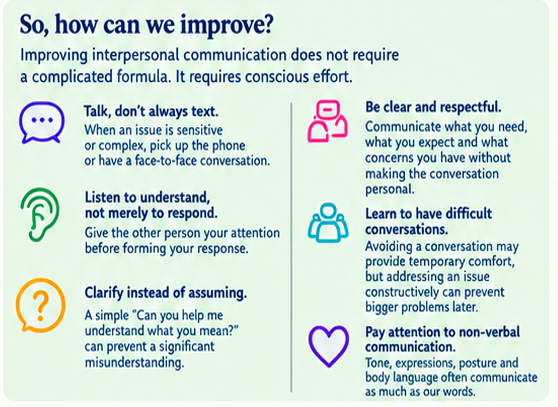
In a world where AI can write our emails, technology can connect us across continents and messages can be delivered instantly, interpersonal communication reminds us of something technology cannot completely replace:
Human connection
Because at the end of the day, communication is not just about transferring information.
It is about making sure that people understand people.