
Have you ever walked away from a conversation feeling misunderstood, even
though your message seemed clear? Or perhaps you’ve met someone who instantly
made you feel comfortable, valued, and heard without saying anything extraordinary.
These experiences remind us that effective communication is about much more than
words. In both our personal and professional lives, success often depends not on
what we say, but on how we connect with others.
The ability to build understanding, trust, and meaningful relationships through
communication is known as interpersonal communication. It is a skill that influences
every conversation, relationship, and opportunity we encounter.
“Seek first to understand, then to be understood.”
– Stephen R. Covey
“Seek first to understand, then to be understood” is more than just a principle; it is
the foundation of effective interpersonal communication. Many people assume that
communication is simply about expressing their thoughts and ideas clearly. However,
true communication extends beyond speaking. It involves listening attentively,
understanding perspectives, observing emotions, and responding appropriately. A
conversation becomes meaningful when both individuals feel heard, respected, and
valued.
Why is Interpersonal Communication Important?

Stronger bonds are formed, and mutual understanding is facilitated by effective
interpersonal communication. Confusion and misunderstanding are less likely when
people listen intently and speak plainly.
Recognizing that communication is a two-way process is equally crucial. A person
cannot become a successful communicator just by being a good speaker.
Additionally, one needs to be able to listen, comprehend the viewpoint of others, ask
pertinent questions, and react politely.
Confidence, teamwork, leadership potential, problem-solving abilities, and
professional connections can all be enhanced by effective interpersonal
communication. For students getting ready to enter competitive professional settings,
these attributes are very beneficial.
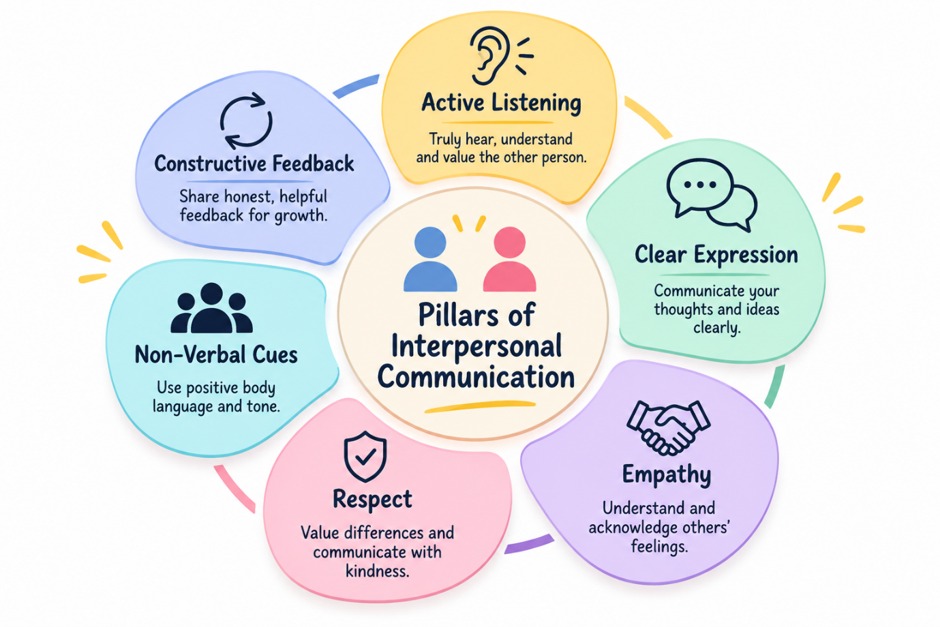
Pillars of Interpersonal Communication