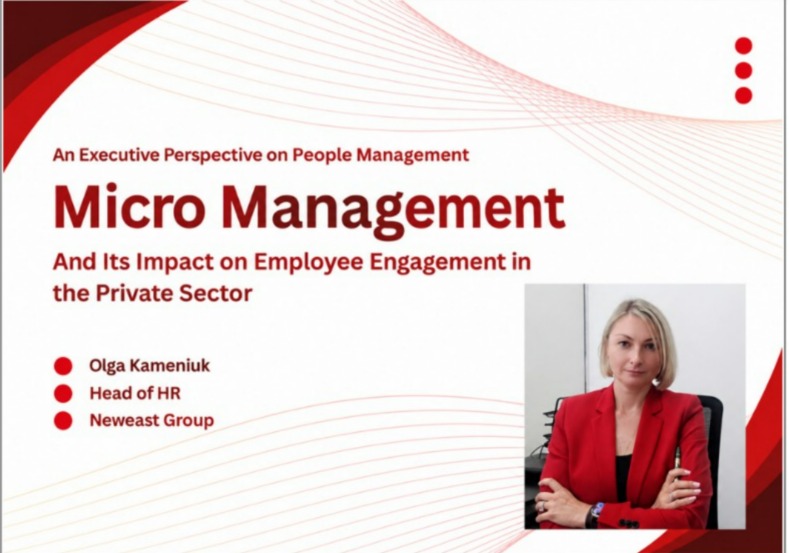

The Changing Role of Management in Employee Engagement
The focus of contemporary management is not only to complete projects and deliver good results. It is equally important to manage people well and to build an engaged workplace. But does every manager know how to lead their team? Building, retaining and developing employees are among the major discussions in management today. Keeping employees engaged and creative is no longer a matter of choice; it is a must for any company that wants to retain and develop talent. Do managers know the different management styles, and that these can be adapted to different circumstances and personalities? Do they spend enough time thinking about how to improve the way they manage people? And do HR leaders pay enough attention to educating their managers and developing them into builders of engaged teams? This article discusses how one management style, micromanagement, can both engage and disengage employees, weighs its advantages and disadvantages, and recommends how to avoid its negative effects in the workplace.

In the private sector, where commercial pressure is high, the pace is fast and every resignation carries a direct cost, companies that want to retain talent can face significant losses from disengaged, often actively disengaged, employees and from staff turnover if they do not pay enough attention to how their line managers work with their teams. Absenteeism linked to disengagement means companies pay salaries for days on which no work is performed. One of the most effective ways to improve engagement is to improve the way line managers work with their direct reports and to build on their strengths. Management style is one of the key influences on employee engagement, and micromanagement is a style that can affect engagement quickly, in either direction. It is also one of the most debated management styles, which makes its effect on engagement worth examining in detail.
Before going further, it helps to distinguish between two very different things that are both called micromanagement. The first, which this article calls default micromanagement, is the familiar negative form: extreme control, lack of trust, refusal to delegate and reluctance to accept other opinions. The second, deliberate close management, is a conscious choice to stay closely involved in the work in order to guide people, develop them and protect results. The difference between the two is not how much attention a manager pays to detail, but why and how that attention is paid.
How Negative Micromanagement Affects Employee Engagement
Default micromanagement leads to mismanagement and disengagement. It is commonly associated with low morale and a loss of motivation and initiative. When managers fail to delegate, employees go on autopilot and lose interest in what they do: they stop suggesting, thinking and creating. Yet one of a manager’s core responsibilities is to help employees work independently by giving them meaningful responsibilities, avoiding unconstructive criticism, and allowing them space to do things their own way while still reaching outstanding results.
Deliberate close management, on the other hand, can support engagement and development. Managers who are closely involved with their teams tend to stay in regular contact, give clear guidance on how to achieve outstanding results, and foresee and prevent mistakes before they happen. Because they know their people well, they can judge when, what and to whom to delegate. This is the key difference from default micromanagement: delegation is not refused, it is planned. To reduce any negative impact on engagement, managers using this approach should still encourage and motivate their teams by delegating thoughtfully and showing trust in their capabilities.
Managers therefore need to learn to recognize when close involvement helps and when it harms. Applied in the wrong setting, micromanagement stifles productivity, creativity and the desire to take responsibility. At the same time, some employees genuinely benefit from closer direction, for example new joiners, people moving into unfamiliar roles, or those who simply prefer more structure. An individual and situational approach is the answer: managers should consciously choose the style that fits each person and each situation. Close attention to detail is particularly valuable when the organization is changing its strategy or taking on a new venture; when there is a new leader, employee or unit; when an employee or leader is underperforming; when results are disappointing; or when a customer raises a serious complaint. Even then, a manager must be selective about what to monitor closely, because trying to control every detail of the organization risks missing other important factors.
Management Styles: Adapting Leadership to People and Situations
Every manager should be able to adapt their style, but using close management as a deliberate strategy requires experience and preparation. It suits leaders who know their business deeply, care strongly about how their vision is executed, and are experts in their field. Steve Jobs, Mickey Drexler and Jeff Bezos are often cited as private-sector leaders who used close involvement strategically to grow their businesses and develop talent. In this form, delegation becomes more careful and detailed: it adds value, prevents mistakes and comes with timely feedback. Such feedback differs from criticism in that it is specific, focused on the work rather than the person, and aimed at helping the employee improve. Thorough, constructive feedback, high expectations and clearly detailed requirements are where people development begins, and where employees become engaged and motivated to grow further.
Negative micromanagement is usually a default that fills the gap left by missing management skills. Its toxicity is rooted in a lack of professionalism and self-awareness: a manager’s lack of confidence turns into an inability to trust and delegate properly. Deliberate close management, by contrast, is a highly developed skill that takes years of training and self-development. This is where HR has a clear role. By investing in training and continuous development for line managers, HR can help them understand the full range of management styles, recognize when each is appropriate, and become professional leaders regardless of the style they choose.