
Introduction:
In a world where artificial intelligence, automation, and digital transformation are reshaping industries overnight, the question is no longer “What do you know?” — it is “How fast can you learn?” Reskilling and upskilling have emerged as the twin pillars of a resilient, future-ready workforce. Whether you are an employee navigating a changing role or an organisation striving to stay competitive, investing in learning is no longer optional — it is survival.

Key Focus Areas
01. Understanding the Difference
Upskilling enhances existing skills; reskilling prepares for entirely new roles.
02. The Automation Threat
Millions of jobs are evolving — learning new skills is the best defence.
03. Benefits for Employees
Greater job security, higher pay, and a sense of purpose and growth.
04. Benefits for Organisations
Improved retention, productivity, innovation, and reduced hiring costs.
05. Tools & Platforms
Online courses, mentoring, on-the-job training, and micro-credentialing.
06. Building a Learning Culture
Organisations must embed continuous learning into their DNA.
Understanding Reskilling vs. Upskilling
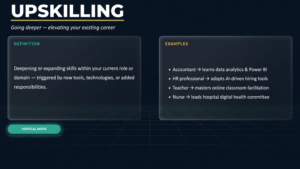
Though often used interchangeably, reskilling and upskilling serve distinct purposes. Upskilling means enhancing your current capabilities — a marketing professional learning data analytics, for example. Reskilling, on the other hand, means acquiring entirely new competencies to transition into a different role — such as a factory worker learning to code to become a machine learning technician.
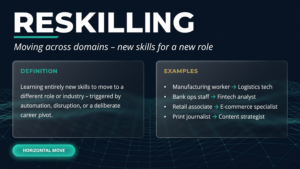
Both are critical. Upskilling keeps professionals relevant within their fields; reskilling opens entirely new career paths. Together, they form a comprehensive learning strategy that prepares individuals and organisations for an uncertain future.
Why It Matters Now More Than Ever
The World Economic Forum estimates that by 2027, over 85 million jobs may be displaced by automation and AI — while 97 million new roles will emerge. The gap between these two realities is filled by learning. Industries such as healthcare, technology, manufacturing, and finance are already experiencing acute talent shortages, not because of a lack of candidates, but because of a lack of the right skills.
Employees who proactively engage in training programmes enjoy greater job security, increased earning potential, and deeper workplace satisfaction. Organisations that invest in their people see measurable gains — higher retention rates, stronger innovation pipelines, and reduced recruitment costs.
“The illiterate of the 21st century will not be those who cannot read and write, but those who cannot learn, unlearn, and relearn.”
— Alvin Toffler
Effective Approaches to Training
Successful reskilling and upskilling programmes are not one-size-fits-all. The most effective strategies combine multiple modalities:
Online learning platforms (Coursera, LinkedIn Learning, Udemy) provide flexible, self-paced courses across virtually every domain. On-the-job training pairs learning with real-world application, accelerating retention. Mentorship and coaching offer personalised guidance that no algorithm can replicate. Micro-credentials and certifications give learners tangible proof of new competencies, valued by employers.
Organisations must also personalise their approach — assessing individual skill gaps, aligning training with business goals, and creating psychological safety so employees feel comfortable admitting what they do not know.
Building a Culture of Continuous Learning
Training programmes alone are insufficient. The real goal is to embed a learning mindset into the fabric of organisational culture. Leaders must model curiosity, budget for development, and recognise learning as a business-critical activity — not a perk. When learning becomes part of everyday work rather than an annual event, transformation follows naturally.
Conclusion
The Future Is Learned, Not Inherited
Reskilling and upskilling are not short-term HR initiatives — they are strategic imperatives for the decade ahead. In a landscape defined by relentless change, the most valuable asset any professional or organisation can possess is the ability to adapt. Start small: identify one skill gap, commit to one learning resource, and take one step today. The future does not reward those who wait — it belongs to those who prepare.