
A few years ago, I sat across from a young software developer during a mock interview. His technical answers were flawless — clean logic, the right jargon, all of it. But when I asked him to explain a project delay to an imaginary client, he froze, mumbled, and finally said, “I’m not good at this part.”
He didn’t lack knowledge. He lacked a language for people. That gap — between what we know technically and how we connect it to others — is the essence of interpersonal communication, one of the most in-demand soft skills in today’s workplace. It decides more careers than most of us realise.
What Exactly Is Interpersonal Communication?
Simply put, interpersonal communication is the way two or more people exchange thoughts, feelings, information and ideas while building or maintaining a relationship. It is much more than talking — and as a soft skill, it sits right alongside emotional intelligence, teamwork and adaptability as something employers actively train for.
WORDS + TONE + LISTENING + BODY LANGUAGE + EMOTIONS + UNDERSTANDING
A Short History of a Very Old Skill
Communication has existed for as long as human beings have existed. Before emails and smartphones, people communicated through spoken language, gestures, stories and symbols. Over time, researchers began studying not only what people communicate, but how relationships develop through it.
One key idea is Social Penetration Theory (Altman & Taylor, 1973), which explains how relationships deepen gradually as people move from superficial exchange to real self-disclosure. Think of it like an onion: we start with “What do you do?”, then “Where are you from?”, and eventually, once trust builds, something we don’t usually tell people. That gradual openness underlies every strong professional relationship too.
The Four Foundations
The simplest way to teach interpersonal communication as a soft skill is through four foundations:
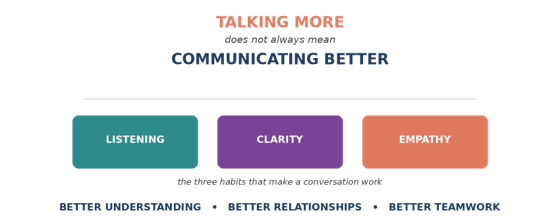
Listening — paying attention to what someone is actually saying, not just waiting for your turn.
Empathy — understanding another person’s perspective without immediately judging it.
Clarity — reducing confusion instead of creating it.
Respect — disagreeing with an idea without disrespecting the person.
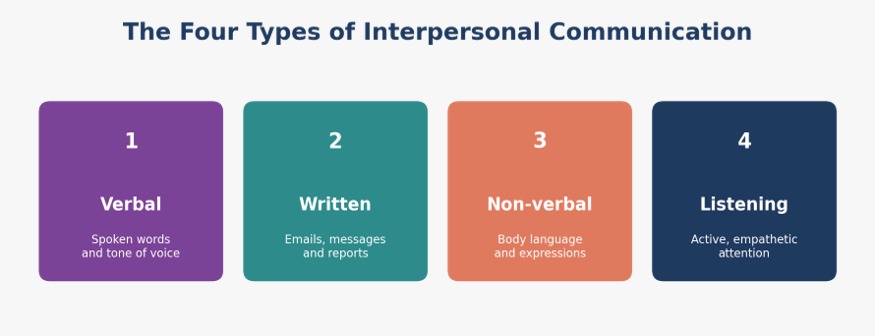
The Four Types of Interpersonal Communication
Every interaction runs through some mix of these four channels — and most miscommunication happens when they don’t match.
Why It Matters at Work
In a workplace where people don’t listen to each other, meetings stretch longer, instructions get misread, feedback feels personal, and small disagreements grow into conflict. Strong interpersonal communication — practised deliberately, not left to chance — builds clearer expectations and healthier conversations.
“You need to improve your performance” makes an employee feel criticised. “I noticed the last two reports were late — is something making deadlines difficult? Let’s figure it out together” opens a dialogue instead. Same concern, completely different conversation.
Communication Is Not Just About Being Heard
People often don’t need someone to solve their problem immediately — they need to feel heard. Instead of jumping to a solution, try: “Tell me a little more about what happened.” That one sentence can change everything. This is the real shift: from talking at someone to talking with them.
Five Quick Ways to Sharpen It
- Summarise before replying — it catches misunderstandings early.
- Watch your non-verbal signals — mismatched tone causes most confusion.
- Ask before you judge — “Help me understand” keeps the door open.
- Pause before responding — a two-second pause can prevent a two-hour argument.
- Choose clarity over cleverness — simple, respectful language is often best.
What I Am Carrying Into My Corporate Training Journey
Moving from language training into corporate training and facilitation, I am increasingly convinced that soft skills cannot be taught through definitions and slides alone — they must be experienced and reflected upon. Real transformation happens when people start noticing their own communication patterns. That is the training I want to build.
Conclusion
The real goal of interpersonal communication isn’t simply to speak well. It is to create understanding.
And sometimes, the most powerful communication skill isn’t finding the perfect words — it is knowing when to listen.