
The professional journey is rarely a straight line; while technical skills build the road, soft skills are the bridge that helps you cross the gaps between potential and performance.
For decades, technical prowess was deemed the ultimate currency of the corporate world. If you could code it, build it, or analyse it, you were deemed “successful.” However, as we navigate through 2026, the landscape of work has fundamentally shifted. Artificial intelligence and automation have redefined what “valuable” means.
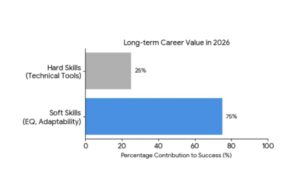
In this new era, technical skills are merely the entry ticket, but soft skills are the key to the executive suite.
Beyond the Technical: Why Soft Skills Are the True Differentiator
The Perfect Fit: Hard skills define your capabilities, but soft skills define your culture. Professional mastery occurs where these two gears meet.
Consider this: hard skills can become outdated in just a few years; a phenomenon sometimes called the “half-life” of technical skills. A software developer who cannot communicate their ideas to a client or collaborate with teammates will inevitably plateau. In contrast, someone with strong interpersonal skills can navigate complex projects, build trust, and turn challenges into opportunities. Link
Top Soft Skills Powering Success in 2026
- Emotional Intelligence (EQ): Teams led by emotionally intelligent leaders outperform others by up to 35% in productivity.The EQ Advantage: Understanding the five pillars of emotional intelligence allows you to lead with empathy and build high-trust relationships.
- Critical Thinking & Problem-Solving: AI handles data, but humans must interpret context.The Human Filter: Critical thinking allows us to move from ‘data’ to ‘decision’ by asking the right questions.
- Advanced Communication: In a hybrid environment, clarity is non-negotiable. It’s about transforming complex data into a simple, engaging story.
Beyond Words: Leadership communication isn’t just about speaking; it’s about aligning a team’s vision through clarity and active listening Link
The Protouch Guide: Master Your “Power Skills”
Soft skills in action: Real-world success is a team sport. Cultivating adaptability and collaboration is the best way to thrive in 2026.
Soft skills are not fixed traits; they are muscles that can be developed. To truly master these, consider structured certification paths that move beyond theory: Link
- Become an EQ Leader: Specialized programs like the Certified Emotional Intelligence Trainer & Coach help you master self-awareness and empathy as strategic leadership tools.
- Elevate Your Vision: For those moving into management, a Certified Leadership Excellence Program can provide the framework to influence and empower teams effectively.
- Refine Your Facilitation: Learn to guide diverse teams by becoming a Certified Corporate Trainer, focusing on high-impact communication and engagement. Link1 Link2 Link3 Link4
Conclusion
As AI automates the mundane, humans are left to handle the nuanced, creative, and relational aspects of work. The future belongs to the “human professionals”; those who communicate clearly, lead with empathy, and work well with others. Invest in your soft skills today, and you are not just ensuring your career growth; you are future-proofing it.
About the Author: Bhagyalaxmi Nayakar is a Corporate and Soft Skills Trainer dedicated to human-centric leadership in the digital age. With a keen interest in how “power skills” drive business outcomes, Bhagyalaxmi writes frequently on professional development, effective communication, and the future of work. They believe that while AI may change how we work, soft skills define why we succeed.