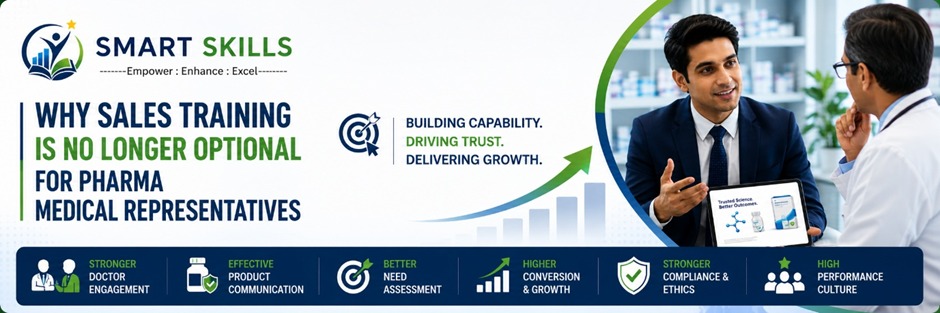

In today’s highly competitive pharmaceutical industry, product quality alone is no longer enough to drive growth. Doctors are overloaded with information, competition is increasing rapidly.
In such an environment, the real differentiator for a pharma company is the capability of its Medical Representatives (MRs).
For small and mid-sized pharma companies, this challenge becomes even more critical. Offering structured sales training for their field force.
A well-trained MR does not merely promote products; he builds trust, communicates scientific value, handles objections professionally, and strengthens the company’s market presence. Sales training transforms average representatives into confident brand ambassadors.
Identifying the Pain Points
Many pharma companies unknowingly suffer from performance gaps that are directly linked to inadequate training. These gaps may not always appear immediately, but over time they significantly impact prescription generation, doctor relationships, and revenue growth.
Some of the most common challenges faced by companies without structured sales training programs include:
- Poor Doctor Engagement
Many MRs struggle to create meaningful conversations with doctors. Their communication often becomes product & price-centric rather than solution-oriented. As a result, doctors lose interest quickly.
- Lack of Confidence in Product Presentation
Even experienced representatives sometimes fail to explain product benefits effectively. Inability to handle scientific discussions reduces credibility in front of healthcare professionals.
- Weak Objection Handling
Doctors frequently raise objections related to efficacy, pricing, competition, or patient compliance. Untrained MRs often become defensive or fail to respond convincingly.
- Inconsistent Field Performance
Without standardized training, every MR develops his own working style. This creates inconsistency in communication, reporting, and sales execution across territories.
- Low Motivation and High Attrition
Employees who are not guided properly often feel unsupported. This leads to reduced motivation, lower productivity, and eventually higher employee turnover.
- Ineffective Time and Territory Management
Many field professionals spend significant time on low-value activities due to lack of planning skills. Poor call management directly impacts doctor coverage and sales productivity.
These challenges collectively affect business growth, market penetration, and brand positioning.
Diagnosing the Possible Remedy
The solution is not simply increasing sales targets or monitoring field activity more aggressively. The real solution lies in capability building.
A structured sales training program helps pharma companies bridge the gap between product knowledge and field execution. Training equips MRs with the practical skills needed to influence doctors professionally and ethically.
Effective pharma sales training should focus on both behavioral and functional competencies.
A successful training framework generally includes:
- Doctor call effectiveness
- Communication and presentation skills
- Scientific selling techniques
- Objection handling
- Negotiation skills & Relationship building
- Time and territory management
- Confidence and personality development
Training should not be treated as a one-time event. Continuous learning and reinforcement create long-term behavioral change.
Companies that invest consistently in sales capability development often witness improved prescription generation, stronger doctor retention, better morale, and higher sales productivity.
Practical Solutions for Pharma Companies
To build a high-performing field force, pharma companies should adopt a systematic and practical approach toward sales training.
Recommended Action Points
- Conduct regular training need analysis for the field team.
- Develop structured induction programs for new Medical Representatives.
- Focus on practical role plays instead of only classroom theory.
- Train first-line managers on coaching and mentoring skills.
- Introduce communication and soft skills training.
- Improve scientific presentation capabilities of MRs.
Areas Where Training Creates Immediate Impact:

- Improved doctor conversion ratio
- Better prescription generation
- Increased confidence during doctor calls
- Higher brand recall among healthcare professionals
- Stronger relationship management
- Reduced field-force attrition
- Enhanced productivity per territory
- Better alignment between management expectations and field execution
For small and mid-sized pharma companies, these improvements can create a significant competitive advantage without requiring massive investments.
Conclusion
Companies that continue to ignore structured sales training may struggle with inconsistent performance, weak doctor engagement, and declining market competitiveness. On the other hand, organizations that invest in developing their people create stronger brands, more confident teams, and sustainable business growth.
Sales training is no longer an expense; it is a strategic investment.
For pharma companies aiming to grow in a competitive market, empowering Medical Representatives through professional training can become the strongest driver of long-term success.