
Team effectiveness has become a central concern in modern organizations characterized by collaboration, interdependence, and knowledge work. While numerous frameworks examine team performance, most focus on either structural role allocation, interpersonal skills, or psychological resilience in isolation. This conceptual paper proposes an integrated framework for measuring and improving team dynamics by combining Belbin Team Roles, Emotional Intelligence (EQ), and Positive Intelligence (PQ). The framework conceptualizes team effectiveness as the interaction of three dimensions: structural role alignment (what team members do), interpersonal competence (how they interact), and psychological resilience (why they sustain performance under pressure). By integrating behavioral role theory, emotional competence, and cognitive resilience, the model provides a comprehensive diagnostic and developmental tool for organizations seeking high-performing teams. The paper contributes to the literature by synthesizing previously independent frameworks into a unified model for assessing and improving team functioning.
1. Introduction
Team-based work has become the dominant mode of organizing in contemporary organizations, particularly in knowledge-intensive and innovation-driven environments. Effective teams improve decision quality, foster creativity, and enhance organizational performance (Hackman, 2002; Katzenbach & Smith, 1993). However, team dysfunction— manifested through conflict, poor communication, or role ambiguity—often undermines performance.
Traditional team effectiveness models emphasize structural and behavioral aspects such as team roles, task design, and leadership (Belbin, 2010; Tuckman, 1965). More recent research highlights the importance of emotional and psychological factors, including emotional intelligence and psychological resilience (Goleman, 1998; Salovey & Mayer, 1990).
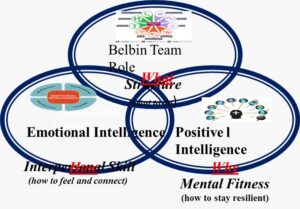
Despite these advances, existing frameworks remain fragmented. Structural role models explain what individuals contribute, emotional intelligence explains how they interact, and mental resilience explains why they persist under stress.
The conceptual integration proposed here builds on the practitioner framework described in the uploaded document, which combines Belbin Team Roles, Emotional Intelligence, and Positive Intelligence to measure both individual and team behaviours.
This study proposes an integrated Team Dynamics Integration Framework (TDIF) that combines these three dimensions to diagnose, measure, and enhance team performance.
2. Literature Review
2.1. Team Role Theory
Meredith Belbin’s Team Role Theory proposes that individuals naturally assume behavioral roles within teams based on their cognitive and interpersonal tendencies. Belbin identified nine roles categorized into action-oriented, people-oriented, and thought-oriented roles (Belbin, 2010).
These roles enable teams to distribute responsibilities effectively and avoid redundancy or capability gaps. Balanced teams tend to outperform those dominated by a limited set of behavioral roles (Belbin, 2010). Role theory has therefore become widely used in team design and leadership development.
However, role allocation alone does not ensure effective collaboration, as emotional and relational factors also influence team dynamics.
2.2 Emotional Intelligence and Team Effectiveness
Emotional intelligence refers to the ability to perceive, understand, regulate, and utilize emotions in oneself and others (Salovey & Mayer, 1990). Goleman (1998) further popularized the concept in leadership and organizational research.
Studies consistently show that emotionally intelligent teams demonstrate:
- better communication
- stronger trust
- improved conflict resolution
- higher collective performance
Druskat and Wolff (2001) argued that group emotional competence significantly predicts team effectiveness. Emotional intelligence therefore plays a critical role in translating individual capabilities into collective performance.
2.3 Positive Intelligence and Mental Fitness
Positive Intelligence, developed by Shirzad Chamine (2012), builds on positive psychology and cognitive-behavioral research. The framework distinguishes between two mental operating modes:
- Saboteur mindset – characterized by self-doubt, blame, and stress
- Sage mindset – characterized by curiosity, empathy, and creativity
Positive Intelligence measures the proportion of time individuals operate in the Sage mode, referred to as PQ score. Higher PQ indicates stronger mental resilience and the ability to handle challenges constructively.
Mental fitness is particularly important in high-pressure team environments where stress and cognitive biases may disrupt collaboration.
3. Conceptual Framework
3.1. The Team Dynamics Integration Framework (TDIF)
The proposed model integrates three complementary dimensions:
| Dimension | Framework | Core Question |
| Structural contribution | Belbin Team Roles | What does each member contribute? |
| Interpersonal effectiveness | Emotional Intelligence | How do members interact? |
| Psychological resilience | Positive Intelligence | Why do members sustain performance? |
This triadic framework corresponds to the three core components illustrated in the conceptual diagram (Figure 1) where Belbin, EQ, and PQ intersect to influence team effectiveness
3.2 Integrated Model of Team Dynamics
The framework proposes that team performance (TP) is a function of three interrelated constructs:
TP = f(Role Alignment, Emotional Competence, Mindset)
1. Role Alignment (Belbin)
Ensures diversity of functional behaviors and balanced task execution.
2. Emotional Competence (EQ)
Ensures effective communication, empathy, and conflict management.
3. Mindset (PQ)
Ensures resilience, positivity, and sustained performance under pressure.
The intersection of these three elements produces high-performing teams characterized by psychological safety, balanced contribution, and adaptive problem solving.
4. Measurement Model
The framework can be operationalized using the following instruments:
| Construct | Measurement Approach | Example Indicators |
| Team Role Structure | Belbin Team Role Inventory | Role diversity, role balance |
| Emotional Intelligence | EQ assessment scales | empathy, emotional regulation |
| Positive Intelligence | PQ score assessment | saboteur control, resilience |
| Team Outcomes | Team performance metrics | cohesion, productivity |
A composite Team Dynamics Index (TDI) can be constructed:
TDI = w1(Belbin Balance) +w2(EQ Score) +w3(PQ Score)
Where weights reflect organizational priorities.
5. Mechanisms of Synergy
5.1. Self-awareness and Behavioral Alignment
Belbin roles identify behavioral tendencies, while EQ enables individuals to manage these tendencies constructively.
5.2 Conflict Resolution
Belbin provides a shared language for discussing differences, reducing personalization of conflict, while EQ enables empathetic dialogue.
5.3 Resilience and Adaptability
Positive Intelligence strengthens the team’s ability to shift from reactive behavior to constructive problem solving.
5.4 Productivity Enhancement
The combined effect of structural alignment, emotional competence, and mental resilience enhances team productivity and collaboration.
6. Practical Applications
The integrated framework can be applied in multiple organizational contexts.
Team Formation
Organizations can design balanced teams by mapping Belbin roles and selecting complementary skill profiles.
Leadership Development
Leaders can develop emotional intelligence and mental resilience while understanding team role dynamics.

Performance Diagnosis
Performance issues can be traced to three sources:
- missing team roles
- poor emotional intelligence
- negative mental fitness culture
Organizational Training
Interventions can target role awareness, emotional skills training, and mental fitness exercises.
7. Implications for Research
This conceptual framework offers several research opportunities:
- Empirical validation of the integrated model
- Development of a multidimensional team dynamics scale
- Longitudinal studies linking PQ and EQ to team productivity
- Cross-cultural testing of team role balance and emotional competence
Future research may also examine how leadership style moderates the relationship between these variables and team performance.
8. Conclusion
This paper proposes an integrated framework for measuring and improving team dynamics by combining structural role theory, emotional intelligence, and mental fitness. Belbin Team Roles provide clarity regarding what individuals contribute, Emotional Intelligence governs how they interact, and Positive Intelligence explains why they sustain performance in challenging situations.
The integration of these frameworks offers a comprehensive model for diagnosing and developing high-performing teams. By addressing structural, relational, and psychological dimensions simultaneously, organizations can create teams that are not only productive but also resilient and collaborative.
References
Belbin, R. M. (2010). Team roles at work (2nd ed.). Routledge.
Chamine, S. (2012). Positive intelligence: Why only 20% of teams and individuals achieve their true potential and how you can achieve yours. Greenleaf Book Group.
Druskat, V. U., & Wolff, S. B. (2001). Building the emotional intelligence of groups.
Harvard Business Review, 79(3), 80–90.
Goleman, D. (1998). Working with emotional intelligence. Bantam Books.
Hackman, J. R. (2002). Leading teams: Setting the stage for great performances. Harvard Business School Press.
Katzenbach, J. R., & Smith, D. K. (1993). The wisdom of teams: Creating the high- performance organization. Harvard Business School Press.
Salovey, P., & Mayer, J. D. (1990). Emotional intelligence. Imagination, Cognition and Personality, 9(3), 185–211.
Tuckman, B. W. (1965). Developmental sequence in small groups. Psychological Bulletin, 63(6), 384–399.